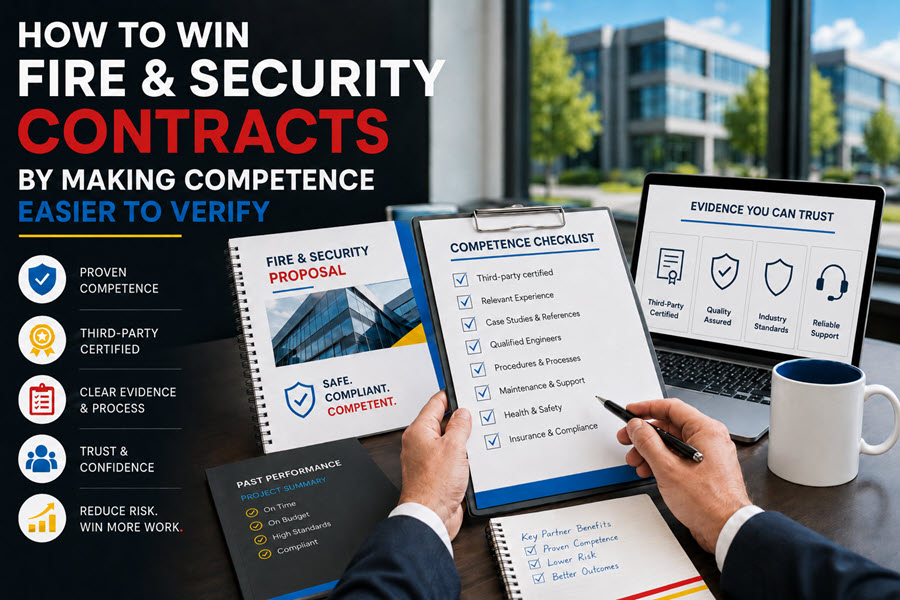
Understanding how to win fire and security contracts at a larger scale — by making competence easier for buyers to verify — is one of the most consistent frustrations we hear from technically excellent installers.
The work is good. The engineers are qualified. The certifications are in order. And yet larger contracts — facilities management companies, housing associations, multi-site commercial clients, local authorities — keep going elsewhere.
The reason is rarely the quality of the work. It is usually something that happens before the work is ever discussed.
How To Win Fire and Security Contracts – How Larger Contracts Are Actually Awarded
Smaller contracts are often won through relationships and reputation. A contact recommends you, someone calls, a quote goes in and work follows.
Larger contracts work differently. Facilities managers, procurement teams and compliance leads operate under a formal due diligence requirement. They are not just choosing a supplier. They are producing a paper trail that demonstrates they appointed a competent company. If something goes wrong — a fire alarm that fails, a system that doesn’t meet the standard it was installed to — that paper trail is what protects them personally.
So when they evaluate suppliers, they are asking a different question to the one most installers expect. Not just “can this company do the work?” but “can I demonstrate that I selected them on the right grounds?”
The Competence Verification Problem
Under the Regulatory Reform (Fire Safety) Order 2005, the Responsible Person — the individual legally accountable for fire safety in a premises — has a duty to appoint competent people to carry out fire safety work. The same accountability principle is moving into the security sector through the Terrorism (Protection of Premises) Act 2025, commonly known as Martyn’s Law.
In practice, verifying competence is harder than it sounds.
The certification landscape in fire and security is genuinely complex. BAFE registration, NSI certification, SSAIB certification, individual engineer qualifications, scheme scope — most procurement teams don’t know what they’re looking at, let alone what to ask for.
They may not know that BAFE SP203-1 covers fire detection and alarm systems specifically, or that a company certificated by NSI or SSAIB for security guarding services holds entirely different certification to one approved for electronic security system installation. We explore what competence actually means in fire safety and how it is evidenced in more detail separately.
When competence is hard to verify, buyers fall back on what they can verify. Familiar names. ISO management systems. Formal compliance documentation. Existing supplier relationships. These become proxies for competence even when they don’t directly evidence it.
The scale of this gap is significant.
According to the NSI and BAFE Fire Safety Buyers Report 2026, 84% of buyers say they use a certified provider — yet 73% of them either do not know who certifies their supplier, are unsure whether their supplier is certified, or use a supplier that is not independently certified.
Buyers want certification. They simply cannot find and verify it consistently.
Where Guarding Companies Have the Advantage
One pattern that appears regularly is specialist fire and security installers losing larger contracts to guarding companies offering CCTV or access control installation alongside their guarding services.
The guarding company wins not simply because of the existing relationship, though that matters. It wins because it presents as more commercially credible in a formal procurement process.
ACS certification, ISO management systems, formal contracts, account management, compliance documentation — all of these signal organisational competence to a procurement team, even if they don’t speak to the specific technical scope of the installation work.
What many buyers don’t know — and many procurement processes don’t ask — is whether the guarding company’s certification actually covers installation work. ACS certification covers security guarding, key holding and mobile response. NSI and SSAIB certification for guarding services covers those specific scopes.
Neither is the same as NSI or SSAIB certification for the installation and maintenance of electronic security systems, which operates under entirely separate scheme criteria. A company certificated for guarding is not automatically certificated for intruder alarm or CCTV installation — even if both certifications are issued by the same body.
The specialist installer who holds the correct installation certification for the scope of work is losing to a company whose certification doesn’t cover that scope — because the buyer doesn’t know the right questions to ask.
We break down exactly how ACS, NSI and SSAIB certification differ — and what a buyer should ask for in a separate guide.
It Is Not Only Guarding Companies
The guarding company scenario is one version of a broader problem. Any situation where a buyer cannot easily verify installer competence creates the same dynamic.
We have seen it with electrical contractors installing emergency lighting to a standard that was superseded twenty years ago — not through negligence, but because nobody in the business was tracking standard updates and no one in the procurement process asked for evidence they were. The work was awarded on familiarity and general credibility. The standard of installation was only discovered when an NSI-certificated engineer visited the site and identified the non-compliance.
Buyers who don’t know what competence looks like in practice can’t select for it reliably. They end up selecting whichever company makes itself easiest to choose — and that is not always the most technically capable one.
What Changes the Outcome
The installers who consistently win larger contracts tend to do one thing differently. They make their competence legible before the procurement conversation starts.
That means the right certifications clearly visible — scheme scope, not just logo. Evidence of comparable projects and environments available without having to be asked. Individual engineer qualifications documented. SKEB-style competence questions answered proactively rather than reactively.
One company we worked with took this further than most. They assembled a Dropbox folder containing every document a procurement team or Responsible Person would need to demonstrate due diligence — certifications, scheme scope documentation, engineer qualifications, comparable project evidence, insurance documents.
When a larger contract opportunity arose, that pack went out as part of their first response. They removed the friction from the competence verification process entirely. It became significantly easier to choose them than to choose anyone else. It worked for them. Results vary. What happens next depends on the contract, the buyer and how competitive the bid was.
That approach doesn’t require anything a well-run fire and security company doesn’t already have. It requires organising what exists and presenting it in the way a buyer actually needs to see it.
The same research found that 94% of buyers value proof of competence over cost when selecting a fire safety provider. Making competence easy to verify is not just good practice — it is what the majority of buyers are actively looking for.
The Shift That Martyn’s Law Will Drive
For security work specifically, the Terrorism (Protection of Premises) Act 2025, known as Martyn’s Law, received Royal Assent on 3 April 2025. It is not yet in force. Commencement is expected in spring 2027. The Home Office published its statutory guidance in April 2026, and commencement regulations made that June switched on the Security Industry Authority’s own duties as regulator.
Scope turns on capacity. Standard duty premises are those where 200 to 799 people may reasonably be present at the same time. Enhanced duty premises and qualifying events start at 800. Both tiers will have to notify the SIA. Enhanced duty premises carry additional duties on top: public protection measures, a designated senior individual, and a documented assessment sent to the regulator.
Every set of qualifying premises will therefore have a named individual accountable for security decisions. The 2025 Act calls that individual the responsible person. That is a security term with its own duties under that Act. It sits separately from the Responsible Person under the Regulatory Reform (Fire Safety) Order 2005, which is a fire safety role. The same phrase, two different pieces of law.
When an individual is personally named as accountable for security decisions at a venue, the question of whether their appointed installer holds the correct certification becomes a personal liability consideration rather than a procurement preference.
Buyers who understand their exposure will look for installers who can demonstrate competence clearly, and a competitive quote will not settle it on its own. The direction of travel in both fire and security is the same: compliance accountability is moving closer to the individual making the purchasing decision. That changes what they look for and how carefully they look for it.
The installers who have already made their competence visible, documented and easy to verify will have less to do when commencement arrives. The ones who are still relying on reputation and relationships to carry them through procurement processes will find those processes becoming harder to navigate.
The Real Competitive Advantage
Larger contracts don’t automatically go to the most technically capable fire and security installer. They go to the company that makes its competence easiest to verify in the way procurement teams need to see it.
That is not a technical problem. It is a positioning problem. And it is one that can be addressed without changing anything about the quality of the work being delivered.
The underlying reason most certified companies lose work to less qualified competitors is explored in detail in our piece on the biggest fire and security marketing mistake.
If you’d like to explore how buyers research and choose fire and security installers before they make contact, our piece on how fire and security companies generate consistent work covers the full picture.
When you’re ready to look at how your business presents its competence to the buyers who need to verify it, book a call with Jo. That’s exactly what our Find The Gaps process is built to uncover. Or if you’d like to understand how we help Fire & Security companies make their competence commercially visible first, explore our Fire & Security digital marketing service.
This article references the Regulatory Reform (Fire Safety) Order 2005, which applies in England and Wales, and the Terrorism (Protection of Premises) Act 2025, which applies across the UK. Different fire safety legislation applies in Scotland and Northern Ireland. It is not legal advice. For specific compliance or due diligence questions, readers should seek advice from a qualified solicitor or competent fire safety professional.