You’re not just being asked to BE competent. You’re being asked to show it, because the person appointing you is the one who has to make that judgement.
Most installers don’t think about fire safety competence like that — and most Responsible Persons don’t realise they’re expected to.
As an installer, you train.
You gain experience.
You do the work properly.
That is competence.
But that’s not what gets tested if something goes wrong.
Fire Safety Competence Requirements Explained
Competence in fire safety is a two-sided duty. The person doing the appointing has to satisfy themselves. The person being appointed has to actually be competent.
The appointing side
- The Regulatory Reform (Fire Safety) Order 2005, Article 18 requires the Responsible Person to appoint one or more competent persons to assist with the preventive and protective measures.
- Regulation 11E(2) of the Building Regulations 2010 goes further, and it is the provision most people miss. Before permitting someone to carry out building work or design work, the person proposing to use them must take all reasonable steps to satisfy themselves that person meets the competence requirement.
Read that second one again, because it is doing something unusual. It does not say the contractor must prove anything. It puts the obligation on the person proposing to use them to reach a judgement. And a judgement can only ever be made on the evidence in front of the person making it.
The appointed side
- The Building Safety Act 2022 set the wheels in motion, and the competence duty now sits in Regulation 11F of the Building Regulations 2010, introduced via Part 2A in 2023. It requires individuals to have the necessary skills, knowledge, experience and behaviours, often referred to as SKEB. Where the appointee is a company, organisational capability is required instead.
- Regulation 11Q(4) defines what those behaviours include: complying with the relevant requirements, refusing to carry out non-compliant work, cooperating with others, and refusing work that is beyond your skills, knowledge or experience while asking for help where you need it.
- Regulation 11E(6) makes the point sharper still. A request to carry out the work must not be accepted at all by someone who does not meet the competence requirement at the time of appointment.
One important limit. Regulation 11F applies where the work falls within the Building Regulations as building work or design work, and the 2023 amendment is an England instrument. It should not be read as a competence duty covering every fire alarm installation, service visit or maintenance contract. Different duties apply in different circumstances. Where a competence duty applies, the person appointing still has to judge whether the person they are appointing is competent.
But none of this tells anyone:
how that competence should be proven
So when something is challenged later — by an insurer, an investigator or a court — the question isn’t:
“Were they competent?”
It becomes:
“Can the Responsible Person prove they were competent?”
From the Other Side of the Decision
The reality for the Responsible Person is this:
In most cases, they aren’t a fire safety expert.
But under Article 18 of the Fire Safety Order, they are still expected to make decisions about competence.
Which often means relying on:
- what they’re told
- how confident it sounds
- and what looks credible on the surface
So when a contractor says:
“We’re competent”
“We’re compliant”
There’s a natural tendency to accept that.
Where the Risk Really Sits
This isn’t tested at the point of decision.
It’s tested later.
When something is reviewed, investigated or challenged, the focus shifts to:
“What evidence was there that this was the right choice?”
Not how confident it sounded.
But:
what was actually relied on
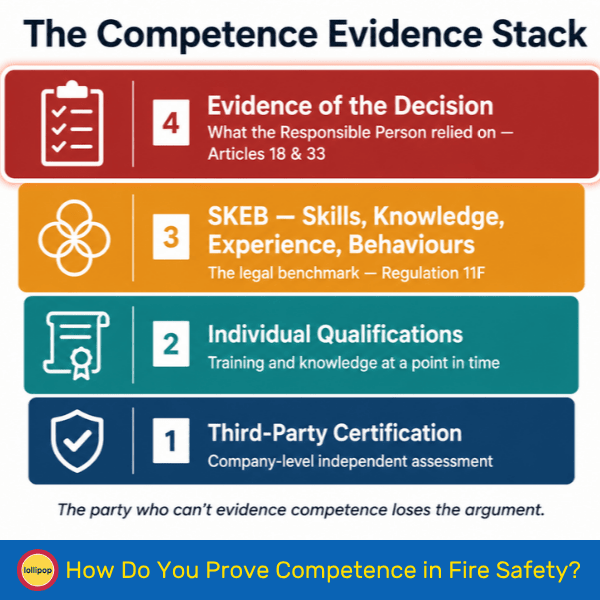
How to Prove Competence in Fire Safety (The Evidence Stack)
A judgement about competence is built from layers of evidence.
1. Third-party certification (company level)
Shows:
- independent assessment
- systems and processes
- some level of audit
Valuable from a decision-making point of view.
But it doesn’t prove:
the individual engineer doing the work was competent for that job
2. Individual qualifications (person level)
Shows:
- training
- knowledge at a point in time
But not:
consistent real-world competence
3. Skills, Knowledge, Experience and Behaviours (SKEB)
- Skills → can they do it?
- Knowledge → do they understand it?
- Experience → have they done it enough?
- Behaviours → do they act within their limits?
This is the legal benchmark set in Regulation 11F of the Building Regulations 2010.
Regulation 11Q(4) is specific about what the “behaviours” element actually means — it includes refusing to carry out non-compliant work, cooperating with others and refusing work that is beyond a person’s skills, knowledge or experience.
4. The Missing Layer — Evidence of the Decision (Responsible Person)
This is what most people overlook.
It’s not just:
- what the contractor has
It’s:
- what was checked
- how they were selected
- why that decision was reasonable
Because if something goes wrong, the question becomes:
“What did you rely on to decide they were competent?”
Article 33 of the Fire Safety Order sits later in the picture. If proceedings are brought for an offence under the Order, it can provide a due-diligence defence to the person charged, subject to the exceptions in the Order, where they can prove they took all reasonable precautions and exercised all due diligence to avoid the offence.
That makes contemporaneous evidence important. But Article 33 does not itself create the duty to verify a contractor’s competence.
The practical consequence:
Where a person has a duty to satisfy themselves about competence, being able to show what they checked and relied on can become important if that decision is later challenged.
Why This Still Feels Inconsistent
As an experienced installer, you might be thinking:
“We’ve never been asked for any of this.”
Or as a Responsible Person, you might be thinking:
“I’ve never had to ask for this before.”
Both are often true.
Because day-to-day, nothing forces the question. It’s only when something goes wrong — a fire, an investigation, a claim — that anyone starts asking who was competent and how it was proven.
By then, the answer either exists or it doesn’t.
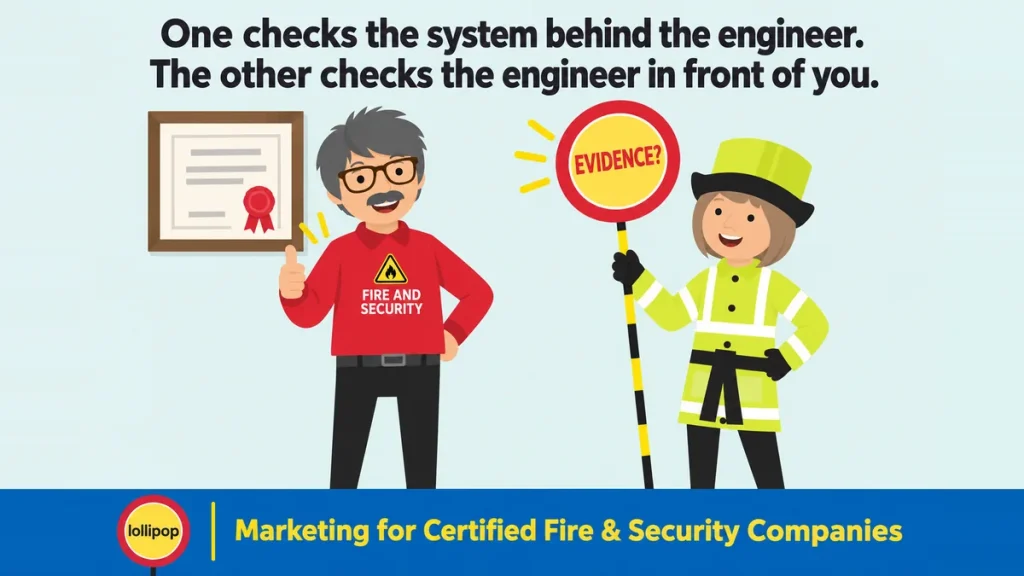
Where Third-Party Certification Helps — And Where It Doesn’t
Certification gives:
independent evidence that someone has been assessed
Third-party certification doesn’t exist in isolation. British Standards help define the technical requirements. Scheme owners such as BAFE turn those requirements into assessment criteria and UKAS-accredited certification bodies such as NSI and SSAIB assess companies against the relevant scheme, whether that is a BAFE scheme or one of their own. Trade bodies such as the FIA and BSIA may provide additional professional assurance, but membership is separate from the certification itself. When a contractor says they’re “third-party certified,” that’s the chain you’re relying on.
From a Responsible Person’s perspective, that helps answer:
“Did I rely on something reasonable?”
But it does not guarantee:
- every individual engineer is competent
- the task is within scope
- the work is correct in that instance
So:
It supports a decision — it doesn’t replace it
Training vs Proving Competence
Training demonstrates learning.
Competence goes further. It is about having the necessary skills, knowledge, experience and behaviours for the work in question.
Independent assessment can provide useful evidence of that competence. But it is evidence of competence rather than the legal definition of competence itself.
When training and assessment sit too close together, the line between:
- “has learned”
- “can do”
becomes blurred.
Turning SKEB into Real Questions
For the Responsible Person:
- Skills → “Can you show examples of this exact work?”
- Knowledge → “What standards are you working to?”
- Experience → “How often do you do this?”
- Behaviours → “What do you do if something is outside your competence?” (this question maps directly to Regulation 11Q(4) — refusing work beyond your competence is a legal behaviour, not just good practice)
These are not technical questions.
They are decision questions.
What This Means for Installers
Those questions shape how you need to respond.
It’s no longer enough to say:
- “We’re accredited”
- “We’re trained”
- “We’ve been doing this for years”
You need to show:
- who will do the work
- how their experience applies
- what standards you follow
- how you operate in practice
- where your limits are
Because your customer is buying:
confidence they can defend their decision to choose you
This is the angle we cover in more depth in marketing your SKEB — turning the same competence evidence the law expects into the marketing that wins work.
What Happens When the Evidence Isn’t Clear
The issue doesn’t show up immediately.
It appears later:
- after a fire
- during an investigation
- during an insurance claim
Then the focus becomes:
“Who did the work — and how was their competence established?”
If the trail is unclear, it becomes much harder to demonstrate what was checked, what was relied on and why the decision was reasonable.
What Good Looks Like in Practice
Good decisions are built on:
- multiple forms of evidence
- aligned to the actual work
- documented at the time
For the person making the appointment
- what you relied on
- what you checked
- why the decision made sense
For the installer (Regulations 11E and 11F)
- have the competence for the work and make the evidence of it easy to find
- refuse work that falls outside your skills, knowledge or experience
The Shift That’s Happening
From:
“Getting the job done”
To:
“Being able to prove the job was done properly — and that the right person was chosen”
The Question That Really Matters
So, for installers, instead of leading with:
- “We’re accredited”
- “We’re qualified”
- “We’re competent”
The stronger question is:
“Can we help our customer prove they made the right choice by choosing us?”
Where This Leaves the Evidence
Put the two sides of the duty together and something follows that the law itself never says.
Competence has to exist. That much is settled. But a buyer trying to satisfy themselves about competence is not assessing whether it exists. They are assessing what they can see. Those are different things, and the gap between them is where competent companies quietly lose work.
Certification narrows that gap. It gives independent evidence that an organisation has been assessed against a defined scheme, within a defined scope. It does not answer every question, and it was never designed to. What it does is give a buyer something external to point at when they are asked what they relied on.
The rest of the gap closes or stays open depending on what a company chooses to make visible. Which engineer will attend, and what they have done before. Which standards the work is carried out to. Where the limits of scope sit, and what happens when a job falls outside them. Those regulations do not prescribe that exact set of disclosures. All of it helps a buyer reach and support a reasonable judgement about competence.
Which means the evidence of competence is not filed away for the day something goes wrong. It is doing commercial work every day it is visible, in every decision made about you before anyone picks up the phone.
Want Help Making Your Competence Commercially Powerful?
If this resonates — competent installers being overlooked because the evidence of their competence isn’t visible — our piece on why most Fire & Security companies struggle to win work goes deeper into the visibility problem.
Or if you’d rather just talk it through and find out where the gaps in your competence-led marketing sit, book a call with Jo.
Final Thought
You’re not just being asked to be competent in fire safety. You’re being asked to show it, because someone else has to make that judgement.
FAQs
Do you need third-party certification to prove competence in fire safety?
No — it is not a direct legal requirement under the Fire Safety Order or Regulation 11F of the Building Regulations 2010. But it is one of the most recognised forms of independent evidence and is often relied upon to help demonstrate competence if a decision is challenged.
What is SKEB in fire safety?
Skills, Knowledge, Experience and Behaviours — the four factors used to assess competence, defined in Regulation 11F of the Building Regulations 2010.
Who is responsible for checking competence?
It depends on the work and the legal duty involved. For building or design work covered by Regulation 11E, the person proposing to use someone must take all reasonable steps to satisfy themselves that they meet the Regulation 11F competence requirements, and the person accepting the work must themselves meet those requirements. Under Article 18 of the Fire Safety Order, the Responsible Person must appoint competent people where they are appointing assistance for preventive and protective measures.
Is training enough to prove competence?
No. Training demonstrates learning. Competence under Regulation 11F is about having the necessary skills, knowledge, experience and behaviours for the work in question — including, under Regulation 11Q(4), refusing work that is outside your skills, knowledge or experience.
Why does evidence matter?
Because evidence can become important when a competence decision is later reviewed or challenged. Clear records help show what was checked and what was relied on, and may also matter where a person seeks to rely on the due-diligence defence in Article 33 of the Fire Safety Order.
This article references the Regulatory Reform (Fire Safety) Order 2005, which applies in England and Wales, and competence provisions in the Building Regulations 2010, which apply in England. Different legislation applies in Scotland and Northern Ireland. It is not legal advice. Where competence, due diligence or specific legal duties are in question, particularly in the context of an investigation, prosecution or insurance claim, readers should seek advice from a qualified solicitor or competent fire safety professional.