When Armoury Security + Fire started out, it was a locksmith shop on the high street in Eastbourne. Over four decades, the family business grew generation by generation through word of mouth because of their great customer service. Then they diversified… first into security, then into fire. They accumulated hard-won qualifications: Master Locksmith, BAFE, NSI Gold third party certification for fire and for security. Their engineers knew their trade inside out.
But their website was a single page that showed almost none of it. With their sons joining the business, the company needed more work. It couldn’t rely on word of mouth that created workload peaks and troughs… the feast and famine cycle… so Lee and Sandy needed to know how fire alarm companies get more customers without relying on referrals alone.
When people already knew the name — when they’d been referred — they could go online, confirm the company was real, check the Google reviews and call. For years it worked well enough for them.
But if anyone searched for “fire alarm installation in Eastbourne”, or “CCTV for a commercial premises”, or any of the specific problems Armoury were genuinely qualified to solve? Nothing. The company simply didn’t appear.
That changed when Armoury rebuilt their online presence. You can see how they increased their online visibility here.
The Armoury story isn’t unusual. It’s the story of most fire alarm companies trying to reach customers beyond the ones who already know them — companies that are genuinely excellent at what they do, but invisible to anyone who hasn’t been referred.
We explored the underlying problem behind this in Why Many Fire & Security Companies Struggle to Win Consistent Work.
The Natural Limit of Referrals — and What It Means for Getting More Fire Alarm Customers
Referrals are one of the strongest signals a fire alarm business can receive. If customers are recommending you, you’re doing something right.
But referrals have a geography. They travel through existing relationships. They reach the people already connected to your network — and nobody else.
Beyond that network are organisations actively looking for a fire alarm installer right now. Researching online. Building a shortlist. Comparing companies they’ve never heard of before.
They don’t know anyone who has used you. So they will never hear about you through word of mouth. But they could become your best advocates in the future — if only they could find you in the first place.
Why Fire Alarm Buyers Research Before They Call
Here’s what makes this sector different from most.
Under the Regulatory Reform (Fire Safety) Order 2005, the Responsible Person — the individual legally accountable for fire safety in a premises — has a duty to appoint competent people to carry out fire safety work.
That word, competent, changes the entire buying process.
Buyers aren’t just shopping for a price. They’re building a defensible case for their choice. They need to be able to demonstrate — to insurers, to auditors, to themselves — that they selected a qualified, certified company whose credentials they checked.
So before most buyers pick up the phone, they’ve already:
- Searched online for fire alarm installers in their area
- Reviewed company websites
- Checked for BAFE registration with NSI, SSAIB or equivalent third-party certification
- Looked for evidence of experience with premises similar to theirs
By the time your phone rings, the buyer has often already decided whether you’re worth talking to. The question is whether they found you during that research — or found someone else instead.
The Invisible Dividing Line
This research stage creates a split in the market that most installers never see.
Some companies are consistently found during that process. Their websites explain their specialisms clearly. Their qualifications and third party certifications are visible. Their experience with similar premises is obvious. When a Responsible Person is looking for a fire alarm company in their area, these installers appear — and look credible.
Other companies — often just as skilled, often holding exactly the same qualifications and third party certifications — are never found. Not because they’re not good enough. Because the evidence of their competence isn’t visible to the people searching for it.
The consequences go further than missed enquiries from new customers.

Sandy Westlake, a director at Armoury, noticed it with their existing clients after Lollipop rebuilt their online presence. Customers who’d trusted Armoury for years started calling to say: “We didn’t know you did that” — and proceeded to book installations of services they’d needed all along, from a company they already knew and liked.
If that’s happening with people who already know you, consider what’s happening with buyers who don’t.
In practice, most new fire alarm customers appear when three conditions align. First, the buyer is actively researching a problem they need to solve — often triggered by compliance reviews, building changes or system upgrades. Second, they encounter a company whose credentials, certifications and experience are clearly visible during that research. Third, the company’s expertise matches the type of premises or system they are responsible for. When those three factors align, the buyer reaches out — and what looks like a sudden enquiry is actually the final step of a research process that may have been happening for days or weeks.
What Buyers Can’t See, They Can’t Choose
Many fire alarm companies invest seriously in their standards. Training. Third-party certification. Operational quality. These aren’t small investments — they represent years of commitment to doing the work properly.
Yet that investment rarely shows up online in any meaningful way.
A website might list fire alarm installation, fire alarm maintenance and fire alarm servicing. But it won’t explain the types of premises the company specialises in, the scale of systems they design, the certifications they hold or what clients say about the experience of working with them.
Without that context, a buyer comparing three local companies sees three identical lists of services. And when everything looks the same, the easiest comparison becomes price.
That’s a problem for companies who’ve earned the right to compete on something other than price.
How Fire Alarm Customers Actually Find Installers
In practice, most new customers arrive through one of three routes.
Referrals and existing relationships produce high-trust enquiries and remain valuable. But they’re unpredictable, slow-growing and limited by who your current customers happen to know.
Online search is where a significant share of B2B fire alarm buying now begins. Buyers search, compare and shortlist before making contact with anyone. Companies that appear during this process are considered. Companies that don’t, aren’t.
Consistent visibility over time is what separates installers who receive a steady flow of enquiries from those who don’t. Companies that regularly demonstrate their expertise — through their website, through clearly communicated credentials, through content that answers the questions buyers are already asking — become familiar to buyers who are still months away from making a decision. When that decision arrives, those companies are already on the shortlist.
Familiarity Reduces the Perceived Risk of Choosing You
Consistent visibility tends to produce better enquiries as well as more of them — and the reason is rooted in how fire alarm buyers think.
For a Responsible Person making a compliance-driven appointment, risk is the dominant concern. Not just the risk of a system failing — the risk of having made the wrong choice. The risk of not being able to justify that choice if something goes wrong.
A company that appears during research, communicates its certifications clearly and demonstrates experience with similar premises is a lower-risk choice. Not necessarily because it’s technically superior to a less visible competitor — but because the evidence needed to justify the decision is already there.
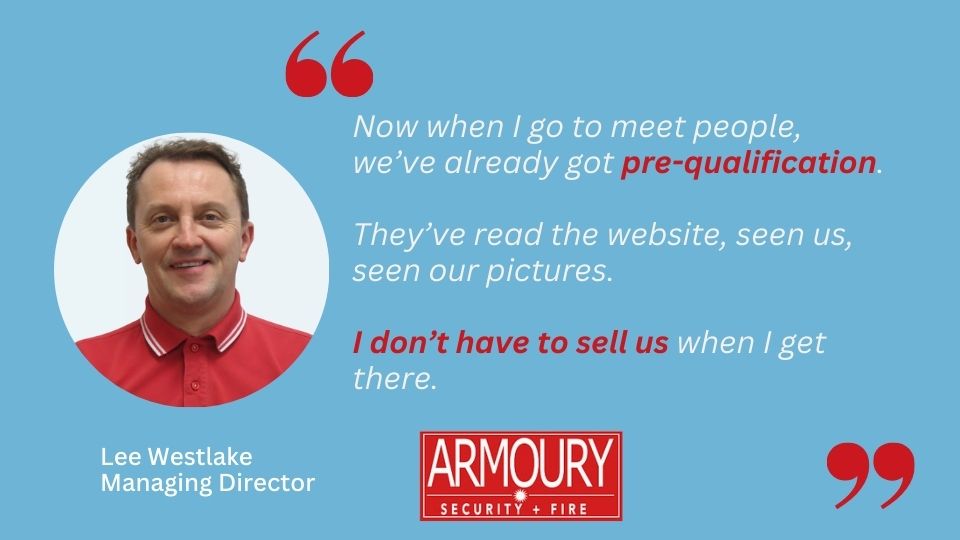
When Lee Westlake described Armoury’s enquiries after their rebrand, he was describing exactly this. “They’ve seen the website, so they know who we are and what we do. I don’t have to sell us.” That’s what happens when your competence is visible to buyers before they call.
We talked about how the type of enquiry a Fire & Security company receives tends to improve when visibility improves in our article called Why Some Fire & Security Enquiries Convert Easily (And Others Don’t)
Making Your Competence Visible to the Buyers Who Are Looking
The goal isn’t to shout louder than competitors. It’s to make it straightforward for buyers who are already searching to understand why you’re the right choice.
That means your online presence needs to clearly show:
- The environments and premises you work in
- The types and scale of projects you deliver
- The certifications and third-party approvals you hold
- What clients say about the experience of working with you
When that information is available during the research stage, your company becomes part of the shortlist naturally — not through interruption or cold outreach, but because a buyer looking for exactly what you do found exactly what they needed.
For most fire alarm companies, the starting point for making that happen is a website that actually reflects the business — one that shows the depth of your experience, your certifications and your specialist knowledge, rather than a generic list of services.
See how Lollipop builds Fire & Security websites can make competence visible to buyers →
How Fire Alarm Companies Get More Customers
Once fire alarm companies understand how customers discover suppliers, the question of how to get more fire alarm customers — consistently, not just when a referral lands — usually follows.
Our Ultimate Guide to Fire & Security Marketing Strategy covers the full picture — or if you want to understand how the growth system works end to end first, start with How Fire & Security Companies Generate Consistent Work.
Or if you’d rather just talk it through, click the button below to book a call with Jo
This article references fire safety legislation applying in England and Wales for context. Different legislation applies in Scotland and Northern Ireland. It is not legal advice. For specific compliance or due diligence questions, readers should seek advice from a qualified solicitor or competent fire safety professional.