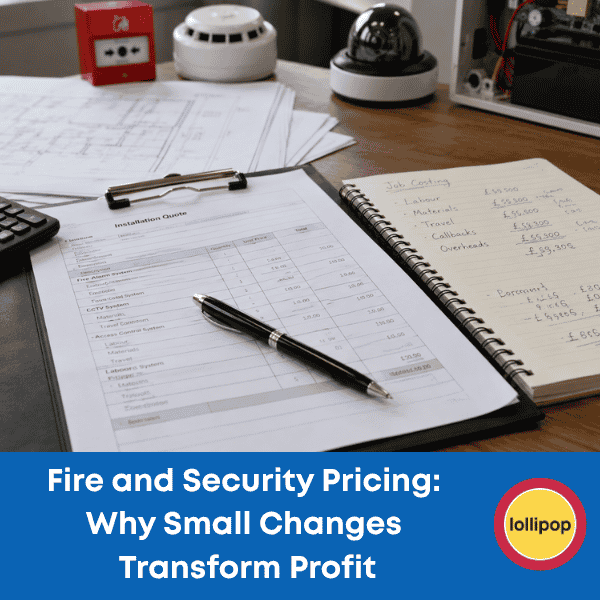
Fire and security pricing decisions shape your margin more than almost anything else in the business — yet they are one of the most consistently overlooked areas we encounter when working with installers.
Most Fire & Security companies focus on one number: revenue. How many installations have we sold this month? How many projects are in the pipeline? What does turnover look like next year?
Revenue matters. But two companies can generate the same turnover and end up with completely different financial outcomes. The difference usually comes down to one thing: how the work is priced.
Revenue Growth Doesn’t Always Mean Profit Growth
Across the Fire & Security sector, a common pattern appears.
Installation companies invest in marketing and grow their turnover year after year, yet profit barely moves. They install more systems, take on larger projects and hire more engineers — but the financial reward never scales with the effort.
One reason is that many installation businesses are operating on very thin margins without fully realising it. Pricing decisions are often made reactively — influenced by what competitors appear to be charging, or by what it takes to win the job — rather than by what the work actually costs to deliver.
The result is a business that is constantly busy, yet not becoming more profitable. We looked at why that happens in more detail in our piece on Fire & Security profit — and where the three main leaks tend to appear.
The Maths That Most Installers Haven’t Seen
There is a financial dynamic at work in every installation business that is worth making explicit.
Consider a Fire & Security company generating £1 million in annual revenue with a 5% net profit margin — a business running a mix of commercial fire alarm installations, intruder alarm systems and a growing book of maintenance contracts. That means the business earns roughly £50,000 in profit after costs.
Now imagine three different ways to improve that position.
Increase sales by 10%. Revenue rises to £1.1 million. After materials, engineer time, commissioning, travel and call-backs are accounted for, profit might rise to around £80,000. A meaningful improvement — but it requires winning and delivering more installations.
Reduce overheads by 10%. Cutting operational costs could increase profit to around £75,000. Helpful — but there is a limit to how far costs can be reduced before it affects the quality of the business.
Increase prices by 10%. If fire and security pricing increases by 10% while core delivery costs — materials, labour, travel and overheads — remain broadly the same, profit could rise to around £150,000.
This is not a forecast. It is a simplified example to show why pricing has such a direct effect on profit once core costs are already covered. Results will vary depending on the business, its cost structure, the types of work it delivers, and how any pricing changes are implemented.
That is the leverage. Once the fixed costs of running the business are covered, additional revenue from better pricing flows much more directly to the bottom line than additional revenue from volume. A modest pricing adjustment can have a disproportionate effect on annual profit — without requiring the business to win or deliver a single additional job.
Why Pricing Fire and Security Work Is Genuinely Difficult
Despite that leverage, pricing is one of the hardest areas to get right in this sector — and for understandable reasons.
Competition is real. Installers are cautious about losing work to a lower quote. But the pressure on pricing often goes beyond direct competition.
Anyone who has worked as a subcontractor to a Tier 1 contractor will recognise this: the quote request arrives with the budget already set — the number the main contractor used to win the tender. The subcontractor’s job is to fit inside it, not to price the work properly. Variances get absorbed. Margin disappears before a single engineer is on site.
The same problem appears when work is quoted from drawings that don’t accurately reflect the building as built. Scope expands on site. Extra time gets absorbed. Variances rarely get charged properly — and the margin that looked reasonable on paper quietly disappears during delivery.
The Cost Visibility Problem
Many Fire & Security businesses also lack clear visibility of their true delivery costs — particularly when engineer time, travel and project management are factored in properly alongside materials.
When callbacks absorb engineer time, when small fixes get done without being charged, or when overhead costs aren’t distributed across jobs properly, the true cost of delivery creeps upwards. Work looks profitable at the quoting stage and performs very differently in practice.
Job management tools can help identify where jobs are eroding margin — by tracking engineer time, materials and callbacks against what was quoted. Simpro is one platform used widely across the Fire & Security sector for exactly this. Without that visibility, pricing decisions are based on instinct rather than evidence, and the gap between estimated and actual cost stays invisible until it shows up in the accounts.
Not All Work Carries the Same Margin
Another consistent issue is treating different types of work the same when they carry meaningfully different cost profiles.
In Fire & Security, installation projects, remedial works, service visits and small upgrades often carry very different margins, yet many businesses apply a similar pricing approach across all of them. Understanding what each category actually contributes to profit allows for more deliberate decisions about which work to prioritise — and which work needs to be priced more carefully to be worth doing at all.
This is also why fire and security maintenance contracts are worth thinking about alongside pricing. Recurring servicing work, priced properly from the outset, creates a more predictable margin base than installation projects that are re-priced competitively every time.
The same principle applies to monitoring agreements — work where the ongoing service is handled by the ARC, but the contract sits with your business, creating recurring revenue without recurring engineer visits.
Pricing as a Business Decision, Not Just a Sales Tool
For many installers, pricing is viewed primarily as a way to win projects. In reality, how you price fire and security work is one of the most consequential decisions a business makes.
It shapes profitability, engineer utilisation, capacity planning and the long-term stability of the company. When pricing reflects the true value and cost of the work being delivered, the business becomes easier to run — not just more profitable on paper.
One practical discipline that many Fire & Security companies overlook is tracking quote conversion rates when pricing changes. Many owners assume that increasing prices will cause an immediate drop in sales. In practice, modest price increases often have far less impact on conversion than expected — and the margin improvement on the work that is won more than compensates. Without tracking that data, pricing decisions stay based on instinct rather than evidence.
The long-term effect goes further. Fire & Security companies with strong recurring revenue and healthy margins typically achieve significantly higher acquisition multiples than project-heavy businesses — a direct consequence of how the work is priced and structured from the outset.
In a sector where competence, compliance and reliability carry real consequence, fire and security pricing should reflect the standard of work being delivered — not just the pressure to match the cheapest quote.
That’s why the fastest route to better financial performance isn’t always winning more work. In many cases, it’s ensuring that the work already being delivered is priced to properly protect margin.
When you’re ready to look at where your business is winning and losing margin, book a call with Jo. That’s exactly what our Find The Gaps process is built to uncover.