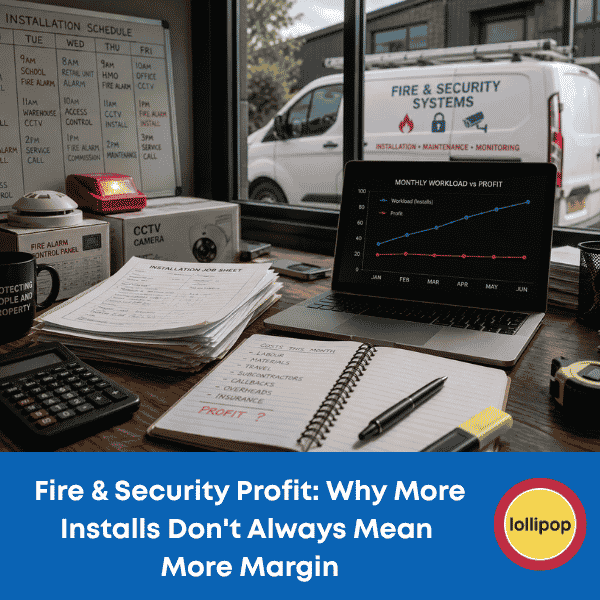
Fire & Security profit is rarely the problem owners expect it to be.
Most expect that doing more marketing and winning more work will resolve it. More installs. More engineers. More projects on the board.
And yet, for many Fire & Security companies, the busier they get, the harder it becomes to understand whether they’re actually making money — or just staying busy.
Revenue Is Not the Same as Profit
This sounds like something you already know. But it gets blurred quickly when you’re running a busy installation business.
A large installation project can feel like a great month. A big invoice lands. The team is occupied. There’s momentum.
But once equipment costs are accounted for, engineer time is properly costed, travel and admin are included and any remedial visits are factored in — the actual margin left over can be considerably thinner than the invoice suggested.
Revenue tells you how much work you’ve done. Profit tells you how much of it you’ve kept. In a Fire & Security installation business, those two figures often drift apart — and the gap tends to grow quietly rather than suddenly.
The Install Trap
There’s a pattern that appears regularly in installation-led businesses.
Work volume increases. Revenue goes up. But profit doesn’t follow at the same rate — or sometimes doesn’t move at all. The business is getting busier without getting more profitable.
The install trap isn’t about doing bad work. It’s about what happens when a business optimises for winning the next project rather than examining what that project actually contributes to the bottom line.
The symptom is a business that always feels like it needs more — more enquiries, more quotes, more installs — just to stay in the same place financially. Engineers are occupied. The owner is working hard. But the numbers don’t quite add up the way they should.
Where Fire & Security Profit Leaks
The causes vary, but three tend to appear most consistently.
Pricing that doesn’t hold margin.
In a competitive market, quotes get sharpened to win jobs. It’s a pattern familiar to anyone who has worked as a subcontractor to a Tier 1 contractor. The quote request arrives with the budget already set — the number the main contractor used to win the tender. The subcontractor’s job is to fit inside it, not to price the work properly. Variances get absorbed. Margin disappears before a single engineer is on site. Over time, underpricing can become the default — not a deliberate strategy, but a habit. Small reductions on individual quotes add up to a meaningful difference across a year’s worth of work.
The same problem appears when installation work is quoted from drawings that don’t accurately reflect the building as built. Scope expands on site. Extra time gets absorbed. Variances rarely get charged properly — and the margin that looked reasonable on paper quietly disappears during delivery.
Costs that aren’t tracked clearly enough.
When call-backs absorb engineer time, when small fixes get absorbed to keep customers happy, or when overhead costs aren’t distributed across jobs properly, the true cost of delivery creeps upwards. Work that looks profitable at the quoting stage can perform very differently once it’s delivered.
No recurring revenue base.
A Fire & Security business built entirely on installations starts each month from zero. Every project that completes takes its revenue with it. The only way to replace it is to win more work — which creates constant pressure on sales, on pricing and on the owner’s time.
These three problems don’t always appear together. But when they do, they compound each other. A company that’s underpricing, absorbing untracked costs and starting each month from zero has very little margin for error — and very little room to build.
How Fire & Security Companies Improve Profit
Installers who shift their focus from volume to margin tend to do two things differently.
First, they look carefully at pricing — not to raise prices across the board, but to understand what each type of work actually costs to deliver and where quotes are being sharpened unnecessarily.
Tools like Simpro can help identify exactly where jobs are eroding margin — tracking engineer time, materials and callbacks against what was quoted. For fire and security businesses specifically, platforms like Uptick bring operational visibility to maintenance and servicing workflows.
Small changes here can have a disproportionate effect on annual profit without requiring any change to the work itself.
Second, they build recurring revenue. Fire & Security maintenance contracts and monitoring agreements create income that doesn’t disappear when an installation completes. They provide a base that new installation work builds on top of — which changes both the financial stability of the business and the pressure on the sales pipeline.
Once a Fire & Security company understands that more installation volume does not automatically mean more profit, two questions matter most. First, is the business building enough recurring revenue through maintenance contracts and monitoring agreements? Second, is the company pricing work in a way that protects margin after labour, materials, travel, admin and callbacks are properly accounted for?
The long-term effect goes further. Fire & Security companies with strong recurring revenue and healthy margins typically achieve significantly higher acquisition multiples than project-heavy businesses — a direct consequence of how the work is priced and structured from the outset.
And we look at fire and security pricing separately — specifically why small, focused adjustments can make a significant difference to margin without requiring a complete overhaul of how you quote.
For the broader picture of why some Fire & Security companies grow consistently while others stay stuck, start with our strategic overview of Fire & Security business growth.
When you’re ready to understand where profit is really being won or lost in your Fire & Security business, book a call with Jo. That’s exactly what our Find The Gaps process is built to uncover.