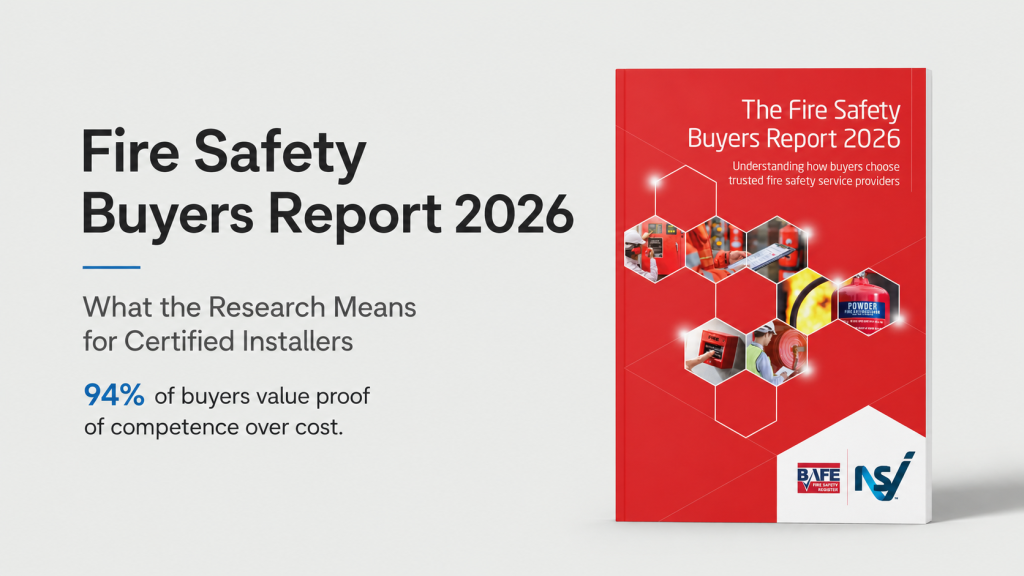
NSI and BAFE have published their Fire Safety Buyers Report 2026 — independent research into how organisations are choosing fire safety service providers. It is the most detailed look at buyer psychology in this sector in years.
If you hold BAFE scheme registration, NSI certification, or any recognised third-party certification, there is a lot in this report that should give you confidence. But there is also one finding that should give you pause — because it reveals a gap between what buyers say they want and what they actually do when they select a provider. Understanding that gap is where the marketing opportunity lies.
The research opens with a challenge to one of the most persistent assumptions in fire and security sales. Most installers behave as though buyers are shopping on cost. They discount to win work. They justify their prices defensively. They lose jobs to cheaper quotes and put it down to buyers being unreasonable.
The research says something different.
When buyers were asked what mattered most when selecting a fire safety provider, proof of competence ranked as the single most important factor. 94% of organisations placed it above cost. Less than a third listed pricing among their top three considerations.
This is not a marginal finding. It is a fundamental challenge to how most fire and security companies present themselves commercially. Buyers are not looking for the lowest price. They are looking for the provider that gives them the greatest confidence — and that they can demonstrate, if challenged, that they made the right choice.
The report is direct about why: as accountability for fire safety sharpens, buyers are placing greater emphasis on being able to explain and defend their choice of provider, not just the price paid.
The post-Grenfell shift is real — but fire safety is still not top of the list
The report confirms what most in the industry already sense. Awareness of fire safety has changed significantly since the Grenfell Tower fire in 2017.
93% of those surveyed say there is greater focus and action on fire safety than there was five years ago. 89% now view fire safety as a strategic business priority. 77% expect to spend more on fire safety over the next five years, with nearly two in five expecting a significant increase.
This looks like a lasting structural shift rather than a short-term reaction to a single event.
But — and this is important for how you market your services — fire safety still ranks fifth in the list of building management priorities. It comes after general health and safety and cost control. It is taken more seriously than it was. It is not consistently at the top of the agenda.
What this means practically: the buyers you most want to reach are not fire safety specialists who know the difference between a BAFE SP203-1 scheme and an SP205 scheme. They are Responsible Persons carrying legal accountability for fire safety on top of a list of other operational responsibilities, under the Regulatory Reform (Fire Safety) Order 2005. They want to get it right. They are not always sure they are getting it right. They are looking for reassurance that they have made a defensible choice.
The Responsible Person is often uncertain — and that is your opportunity
One of the more striking sections of the report concerns the Responsible Person role itself.
33% of decision-makers surveyed expressed some doubt about their legal duties. 38% changed their answer about who the Responsible Person was once the legal definitions were explained to them. 66% selected responsibilities that do not formally sit within that role.
This matters for installers because it explains a behaviour that most of you will recognise: buyers who are purchasing fire safety services without a clear understanding of what they are buying or what they need to demonstrate. They may not know the right questions to ask. They may not know what makes a provider competent versus unverified. They may be making decisions based on familiarity or an existing relationship rather than a proper assessment of capability.
The report makes an observation that is directly relevant to how you position your business. The Responsible Persons who do understand their role are more likely to view fire safety as a moral and ethical duty rather than a compliance necessity — and they are more likely to place importance on reassurance and peace of mind when selecting a provider.
These are the buyers worth targeting. They are research-led, accountability-aware, and they are looking for a provider they can point to when someone asks how they chose. If your competence is clearly visible during their research, you are answering that question before they even call.
Get your copy of the Fire Safety Buyers Report 2026 here
Third-party certification is the primary trust signal — but most buyers cannot verify it
Here is the finding that explains a great deal about how fire safety buying actually works in practice.
83% of buyers agree that third-party certification is the standard route to demonstrating fire assessor competence. 81% say certified providers are worth paying extra for. 79% rank independent auditing and certification among the strongest signals of trust when selecting a provider.
The conviction is strong. But the practice does not match it.
84% of respondents claimed to use a certified provider. When the data was examined more closely, 73% of those respondents either did not know who certified their supplier, were unsure whether their supplier was certified at all, or were using a provider that was not independently certified.
Buyers believe in certification. Most of them cannot tell you whether their current provider is actually certified.
This gap — between the stated importance of certification and the ability to verify it — is one of the most commercially significant findings in the report. It reveals a market in which buyers genuinely want what you offer, but frequently cannot find the evidence they need to choose you with confidence. The problem is not buyer indifference. It is visibility.
When BAFE registration and NSI certification are clearly signposted during a buyer’s research — on your website, in your proposals, in your marketing — you are not adding a badge to a page. You are answering the question that 73% of buyers currently cannot answer about their own suppliers. That is a significant competitive position, and it is one that how you present your competence online either exploits or leaves behind.
What buyers actually mean by “trust”
The report analyses trust using an established framework — the Trust Equation — which defines trust as a function of credibility, reliability and personal connection, divided by self-interest. In the context of fire safety, credibility now carries the greatest weight.
79% of buyers list certification and independent auditing as the primary basis for trust. Brand reputation comes second at 66%. Testimonials account for 33%. Peer recommendations, 23%.
The definition of a trusted provider is shifting. It used to mean someone who was believed to be competent — based on reputation, familiarity, or a track record with similar clients. It is moving towards someone who can demonstrate competence in a way that stands up to independent review.
This has a practical implication for how you sell. Relationships still matter. Reputation still counts. But when a buyer is under pressure to justify their choice — to their board, to an auditor, to a fire enforcement officer — a relationship does not provide the documentary evidence they need. An NSI certificate or BAFE registration that appears on their supplier records does.
The report is explicit: providers who rely solely on relationships, informal references or assumed credibility may find that these signals carry less weight over time than independent proof.
It is a point that matters particularly for companies that have built their business on local reputation and are now finding that reputation alone is not enough to win the larger, compliance-driven work.
Investment is rising — and with it, the expectation of competence
77% of buyers expect to invest more in fire safety over the next five years. Among those who describe themselves as fully aware of their legal fire safety responsibilities, 85% expect spending to increase. Even among those who are only somewhat aware, the figure is 68%.
As organisations invest more, they scrutinise more. The report describes a market in which increased spending is bringing greater attention to the competence of those providing services. Buyers who are investing more in fire safety are less willing to accept unverified suppliers.
For installers who hold third-party certification, this is a favourable direction of travel. As scrutiny increases, the market is moving towards demanding exactly what certified installers already offer. The question is whether buyers can find the evidence they need — and whether certified installers are presenting it in a way that makes selection straightforward.
The three questions that are reshaping how buyers choose
The report identifies three questions that are increasingly shaping how buyers evaluate fire safety providers.
How do you know your fire safety provider is competent? How would you evidence that decision if challenged? What assurance do you have if something goes wrong?
These are accountability questions, not technical ones. A buyer does not need to know the difference between an addressable and a conventional fire alarm system to ask them. They need to be able to answer them to their board, their insurer, or a fire enforcement authority.
For installers, the implication is direct. Marketing that describes what you install does not answer these questions. Marketing that makes your certification, your scope, and your standards visible does.
When a Responsible Person can see your BAFE registration number, verify your NSI approval on the NSI Company Finder, and read a clear description of the schemes you hold and what they cover, they can answer all three questions before they call you. That changes the nature of the conversation — from evaluation to confirmation. Lee Westlake of Armoury Security + Fire described exactly this shift after Armoury made their competence clearer online: “They’ve seen the website, so they know who we are and what we do.”
The gap between intention and practice is your competitive opening
The report describes a market in transition. Third-party certification, delivered through scheme owners like BAFE and UKAS-accredited certification bodies like NSI, is beginning to shift from a competitive advantage to the standard that serious buyers require.
That shift is not complete. Most buyers still cannot reliably tell whether their current supplier is certified. The gap between what they say they value and what they actually check creates an opening for installers who make their certification genuinely visible and easy to verify.
The risk in this market is not that buyers will reject your certification. The risk is that they will not find it — and will default to familiarity, to whoever bids lowest, or to a supplier whose credentials are weaker but easier to see.
The report closes with a choice for providers: wait for regulation or market pressure to force change, or act now to strengthen credibility through independently verified competence.
For installers who already hold that certification, acting now means making sure buyers can find the evidence they need. That is a marketing decision, not a compliance one — and it is the kind of decision we explore further in how to win fire and security contracts by making competence easier to verify.
You can read the full NSI and BAFE Fire Safety Buyers Report 2026 on the NSI website.
If you want to talk through what this research means for how your certifications and registrations are presented online — and whether the right buyers can find the evidence they need — see how enquiry quality changes when competence is visible, or book a call with Jo to walk through your current position.
This article references fire safety legislation applying in England and Wales for context. Different legislation applies in Scotland and Northern Ireland. It is not legal advice. For specific compliance or due diligence questions, readers should seek advice from a qualified solicitor or competent fire safety professional.