A facilities manager sees an advert from a national provider.
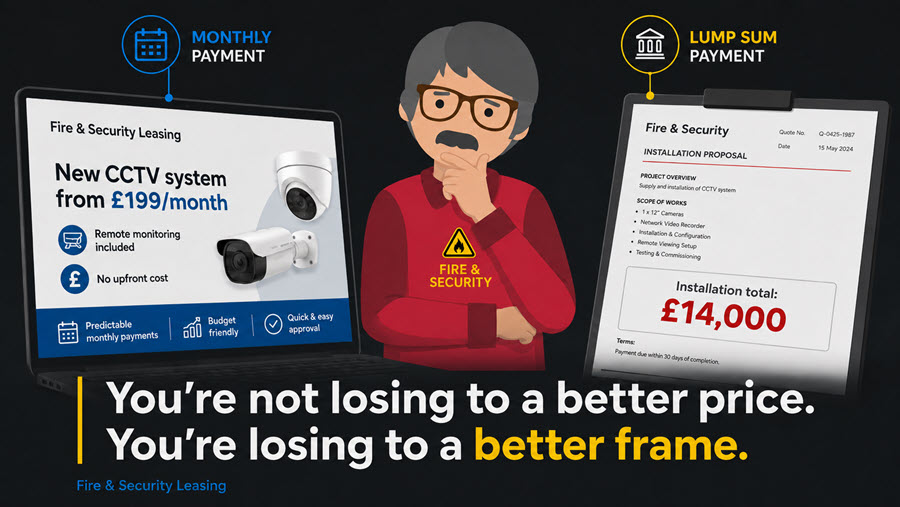
New CCTV system. Remote monitoring included. Spread the cost with manageable monthly payments.
They do not think, “That sounds like leasing.”
They think, “That sounds manageable.”
It feels familiar. Modern. Low-risk. More like software, a phone contract or a subscription than a traditional capital purchase.
By the time they contact an independent installer for a quote, they have already decided what this should feel like to buy. So when a five-figure proposal arrives, the comparison is no longer just about system quality, certification or service.
It is about which option feels easier to approve.
Fire and security leasing gives independent installers a direct answer to that framing problem. But leasing only changes the conversation if the buyer knows about it before they make the comparison.
The Buyer Is Not Only Comparing Systems
Most installers assume the buyer is weighing one system against another. But commercially, they are often comparing two very different frames.
One asks them to justify a large upfront spend. The other asks them to agree to a predictable monthly figure.
Behind that comparison sits a different set of questions:
Can I get this approved? Can I explain this internally? Will this make the decision easier or harder?
For a Responsible Person, facilities manager, landlord or business owner, the issue is not only “which contractor is competent?” It is also “which decision can I defend?”
That defence usually gets made without you in the room, by somebody who has to repeat your argument accurately. We cover who that person is and what they need from you in who really makes the fire and security buying decision.
That is where leasing changes the conversation — but only if it is visible early enough to shape the comparison before it is made.
Leasing Makes the Upfront Cost Less Scary
Many installers offer leasing or equipment finance. Yet if you visited their website, you would never know. The option may be mentioned briefly during the sales process, or buried somewhere in a proposal document. By then, the customer has often already formed an opinion about affordability — and created an unnecessary barrier.
From a buyer’s perspective, there is a real difference between:
“Your new CCTV system will cost £12,000.”
and
“Your new CCTV system can be spread across manageable monthly payments — for example, over three or five years.”
The system is identical. The customer’s perception is not.
Fire and Security Is Often a Grudge Purchase
Most buyers want the outcome — protection, compliance, reduced risk and insurance acceptance — but they are rarely excited about the invoice. Customers know they need it. They are just not enthusiastic about spending money on it. Leasing softens that friction.
A manageable monthly commitment is easier to justify internally than a five-figure capital cost, which means projects that might otherwise be delayed or descoped can proceed. We explore the broader picture of why Fire & Security buyers make decisions the way they do in our Fire Safety Buyers Report 2026 analysis.
National Providers Do Not Always Have a Product Advantage
Large national providers do not always win because they have a better system.
They often win because they have a better frame.
They are not simply selling fire and security equipment. They are selling monthly outcomes — protection, compliance, monitoring and a payment structure that feels easier to approve internally than a five-figure capital cost.
Independent installers can offer a similar frame without sacrificing their technical advantage, their local relationship or their certification standards. Fire and security leasing gives you a monthly figure, a funded installation and an opportunity to retain the ongoing maintenance relationship.
The product gap is often smaller than the buyer thinks. The framing gap is often where the job is won or lost. If you want to understand why certified installers keep losing work to less qualified competitors, our article on how to grow a Fire & Security company covers the full pattern.
Leasing Helps You Compete With National Subscription Providers
This is where leasing moves from idea to competitive tool.
If you are certified and still competing on price, leasing is often the missing piece. Offering leasing does not mean competing on cheapness. It means competing on affordability, flexibility and accessibility — while retaining the installation relationship and creating the opportunity to retain the ongoing service contract, rather than allowing a national subscription provider to own that relationship.
As we explored in our article on equipment finance for fire and security installers, payment flexibility can fundamentally change that dynamic.
For installers considering equipment finance, specialist providers such as Complete Leasing can help explain the available options and funding structures.
Leasing Protects Your Margin
It is also worth understanding why leasing works commercially from every angle in the transaction. For the salesperson, it reframes the affordability conversation before the upfront cost becomes the focus. For the installer, it means being paid once the agreement activates — the finance provider advances the funds, and the customer repays the funder over the agreed term.
For the customer, it can turn a large upfront cost into a more predictable monthly payment.
That alignment across all three parties is what makes fire and security leasing a genuine sales tool rather than just a payment option. And because leasing reframes the affordability conversation around a monthly figure, it reduces the immediate pressure to discount the installation price.
Leasing Makes Upselling Easier
Once a customer has accepted a monthly figure, additional products and upgrades feel far easier to justify. “For an additional £30 per month, we can include remote monitoring and upgraded cameras” lands very differently from “that will be another £5,000.”
Customers who would never sanction a larger upfront cost will often say yes to a modest monthly increase — which means higher average order values without the margin pressure of discounting.
Leasing Supports Maintenance and Protects Retention
Recurring revenue is one of the most valuable assets any Fire & Security business can build. Leasing actively supports it.
Many leasing arrangements are linked to maintenance agreements, creating a natural opportunity to position ongoing maintenance as part of the package from day one, rather than as an afterthought.
We look at this in more detail in Fire & Security Maintenance Contracts: The Business Many Installers Don’t Build.
Leasing Creates Natural Upgrade Opportunities
Customers who purchase systems outright often resist upgrades — they feel they have already paid for the equipment. Leasing changes that conversation. Mid-term upgrades can often be incorporated into revised leasing arrangements, allowing customers to modernise without another major capital expenditure event.
In CCTV particularly, where AI analytics, image quality and storage continue to improve rapidly, this matters. The question moves from “why would I replace something I’ve already paid for?” to “what would another £40 a month get me?”
Some installers use the halfway point of a lease term as a natural moment to discuss upgrades. Improved technology can be introduced as a continuation of the existing monthly arrangement — extending the customer relationship and increasing lifetime value without reopening the full capital-expenditure conversation.
Leasing Only Works If Buyers See It Early
Most installers mention leasing after the survey. By that point, the customer has already compared your five-figure quote with a competitor’s monthly payment. The affordability judgement has already been made.
Leasing mentioned on page four of a proposal is not a competitive advantage. It is a rescue attempt.
By then, your competitor’s monthly-payment frame may already feel easier, safer and more familiar — and no amount of good quote follow-up will undo an affordability judgement the customer has already made.
Leasing creates the biggest competitive advantage when it is visible before the enquiry is submitted, before the survey is booked and before the customer starts comparing quotes. That is the point at which it changes the conversation.
Leasing only becomes a competitive advantage if customers know you offer it before they compare quotes.
With thanks to John O’Connell for sharing his practical perspective on how leasing is used in Fire & Security sales conversations.
How Lollipop Helps
At Lollipop, we help Fire & Security installers make their commercial advantages visible before the first sales conversation takes place — including fire and security leasing, recurring revenue and the other factors that help customers choose one installer over another. We work with installers who want to stop relying on referrals and build a consistent flow of work instead.
We have been working with Fire & Security companies since 2010. Our fire and security installer marketing work starts with finding the gaps — the advantages you already have that buyers simply cannot see yet.
Because the companies winning the most profitable work are rarely the cheapest. They are the companies that make choosing them feel easiest.
Ready to make your business easier to buy from? Book a call with Jo and we’ll show you how to make leasing, maintenance agreements, certifications and your other commercial advantages visible before prospects compare quotes.