A Hidden Piece of Family History
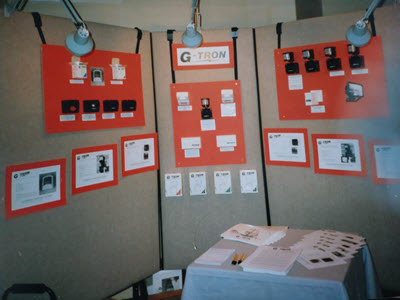
While rummaging through some old photo albums, I came across a faded picture of an exhibition stand labelled “G-tron.” It showed early electronic equipment—some of which looked remarkably like PIR sensors.
At first, I didn’t think much of it. But this single photo uncovered a forgotten chapter of my family’s connection to the security industry – one that predates my own career by decades.
A bit of online digging revealed more about Glazertron’s history and product range, including technical discussions in industry forums and archived directories. What I’d stumbled upon wasn’t just a photo—it was a window into my family’s early involvement in the security electronics world.
My Uncle Julien: Inventor and Early Innovator
Uncle Julien was an electronics whizz. As a kid, I remember a futuristic digital clock he built that proudly sat on Grandma’s mantelpiece. She was so proud of her son’s invention. My mum, on the other hand, remembers it differently—specifically the time she got an electric shock while holding a lamp Julien was “figuring out.”

It turns out Uncle Julien founded a company called Glazertron Ltd., based in Kent, during the 1980s and 1990s. What I’d stumbled upon wasn’t just a photo, it was a window into my family’s early involvement in the security electronics world.
Glazertron: Security Innovation in the 80s
Glazertron specialised in electronic security components – particularly intruder alarm systems. One of their most notable products was the G-Tron 40NL passive infrared (PIR) sensor, which played a vital role in motion detection and alarm systems during that era.
They operated out of a small factory in Upnor Road, Rochester, Kent and contributed to the early development of UK home and business security technology.
Market Challenges and the End of an Era
Despite their innovation, Glazertron faced significant challenges:
- Cheaper imports from abroad, particularly from China
- Difficulty protecting patents and IP rights
- Technical limitations in early motion detection systems
With hindsight – and what we now understand about PIR sensors and radio frequency interference (RFI) – it’s likely that Glazertron’s models, like the G-Tron 40NL, were vulnerable to environmental triggers that caused false alarms.
These challenges weren’t unique to Glazertron. Many early passive infrared (PIR) sensors lacked proper shielding and relied on basic logic to detect motion. That made them especially prone to false triggers from electrical interference, temperature changes and even RF signals – a widespread issue across the security industry in the 1980s.
Of course, PIR sensor technology has come a long way since the 1980s. Modern systems now feature advanced shielding to block radio frequency interference (RFI), adaptive firmware that filters out background noise and smarter integration with other building systems. Combined with better installation standards, these improvements have made today’s alarms far more reliable than their predecessors.
The end of PIR sensor false alarms?
One of the most impactful upgrades has been the rise of dual-sensor detectors. These combine passive infrared (PIR) sensing with microwave technology – and only trigger an alarm when both sensors agree that motion has occurred. By requiring this dual confirmation, they dramatically reduce false alarms caused by heat fluctuations, sudden light changes or minor movements that would have confused earlier systems.
Still, PIR sensor false alarms remain one of the biggest challenges in the intruder alarm industry – particularly in older systems that still use solely PIR detectors or poorly configured setups. And the consequences today can be just as serious, from wasted resources to damaged client trust and fines from emergency services.
📚 Curious about the costs of false alarms and ways to stop them? This guide to false alarms from Armoury Security + Fire explains the impact on Police Response.
🛡️ Want to learn how modern standards help reduce false alarms? Explore the British Security Industry Association’s (BSIA) codes of practice and this FIA (Fire Industry Association) guide to cutting the cost of false alarms.
By the mid-1990s, Glazertron’s flagship PIR model – the G-Tron 40NL – had been discontinued and the company eventually ceased production. Like many small British tech firms of the era, they were edged out by lower-cost imports and the harsh realities of globalisation.
A Creative Mind Beyond Security
After retiring to Spain in the early 2000s, Uncle Julien didn’t stop creating. He even wrote a science fiction novel – sadly, I can’t remember the title, but the octopus-like creature on the front cover is hard to forget!
He passed away a few years ago, but discovering Glazertron has given me a new appreciation for the legacy of innovation in our family.
More Than One Entrepreneur
Looking through our family history, it turns out Uncle Julien wasn’t the only business-minded one:
- His dad, my grandad, was a market trader in the East End, selling fabrics
- My nanny’s family ran petrol stations in Grays
- My dad had his own insurance underwriting business
- Back in the day, it’s said that our family even once owned the land that Wembley Stadium was built on!
From Legacy to Modern Marketing
Understanding my Uncle’s story and Glazertron’s role in early security tech made me reflect on how far the industry has come – and how essential visibility has become.
Back then, companies like Glazertron relied on direct sales and a travelling salesman to spread the word – visiting wholesalers, building relationships with distributors – and attending small industry trade shows to showcase their innovations.
Flagship exhibitions like IFSEC International – first held in 1974 – were powerful platforms for major players in the security industry. But for smaller firms like Glazertron, the costs and logistics of exhibiting at large-scale shows, especially once they moved to Birmingham, were likely out of reach.
Today, your website, your content, your LinkedIn – that’s your travelling salesman. If you’re a Fire & Security professional looking to grow your business, being visible online is no longer optional — it’s essential.
Want to grow your Fire & Security business in today’s digital-first world? This guide might help:
👉 How to Promote Your Fire & Security Business Online
Or if you’re ready to take action, explore our digital marketing services for Fire & Security companies.
A Legacy That Resonates Today
Today, I work with Fire & Security professionals who are pushing the industry forward, just like my uncle did decades ago. Understanding this piece of my family’s history has made my work feel more connected to the roots of the industry. Especially when we’re on our stand at The Security Event.
And it helps me to understand why I care so passionately about success for our customers and for the industry in general.
Whether you’re an installer or a small manufacturer who sells to installers, get in touch to see how we can help your Fire & Security company.