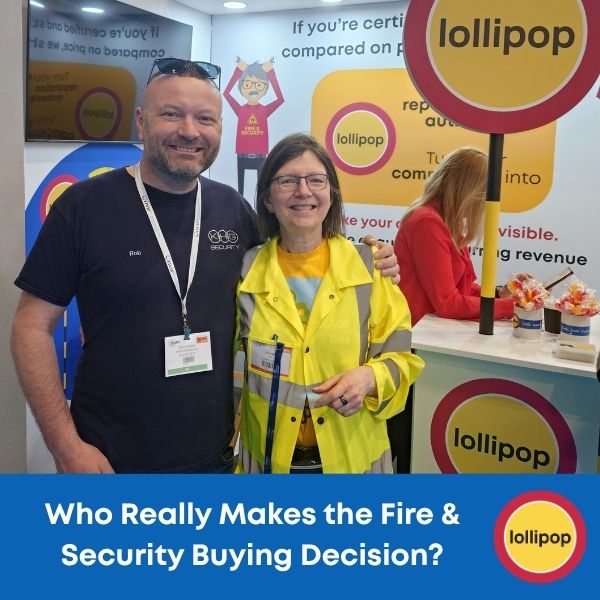
Rob Rathbone is a Director of KHG Security Limited, an SSAIB certified installer in Knutsford, Cheshire. On a Room Secured panel he explained why he sticks with particular manufacturers.
His reason is risk.
He knows which manufacturers actually support the kit when it fails. He knows who takes the issue seriously and who helps get it resolved. He knows who understands what it costs to send an engineer back to site. Because it’s the installer that takes the call at two in the morning. The manufacturer does not.
Now put two alarm quotes side by side. The buyer assumes they are comparing similar systems. Often they are not. One installer chose the kit because it was cheap, familiar or easy to sell. The other chose it knowing how it behaves in the real world and what happens if it fails at the worst possible moment.
That difference never appears in a quote. The phrase “We use quality equipment” just does not capture it. Which matters more than it should, because the person reading that quote is rarely the person who decides.
You already make this decision well
In that story Rob is the buyer, choosing a supplier on how they behave when something fails. You know which distributor answers the phone on a Friday afternoon and which manufacturer asks for the serial number three times. None of that is on a price list. You learned it by getting it wrong.
Your customer is trying to make the same judgement about you, with far less to work with. Rob can test a manufacturer across a hundred installations over a decade and ask other installers what they found. Your customer has a quote, a website and one meeting. Some of them will buy a fire alarm system twice in a working life.
If you sit on the other side of that chain, selling into installers rather than end users, you are the one being judged this way. Rob will form a view of you over years, and he will form it whether you help him or not. That is what our work with fire and security suppliers is built around.
The fire and security buying decision is rarely made by one person
The meeting went well. The facilities manager walked you round the site and asked sensible questions. You ran a proper survey. You priced it properly. You sent a clear proposal.
Then nothing. Three weeks later the job goes elsewhere, decided in a meeting you were not invited to, by people you have never spoken to.
In commercial work the decision can involve three or four people, sometimes more.
The person who enquired. A facilities manager, an operations manager or an office manager. They found you. They understand the problem. They may not control the budget at all.
The person with the duty. In fire work in England and Wales, the Responsible Person has legal duties under the Regulatory Reform (Fire Safety) Order 2005, including putting in place and maintaining appropriate fire safety measures. Government guidance lists the employer, owner, landlord, occupier or anyone else with control of the premises, including a facilities manager or managing agent. So your champion might hold the duty themselves, or might be three steps away from the person who does, and you will not always be able to tell which.
The person with the budget. A finance director, a general manager, sometimes a group board. They have not seen the building. They have not read BS 5839-1 or PD 6662. They are looking at a number against everything else competing for it this quarter.
The intermediary. A managing agent, a consultant or a main contractor. They sit between you and the decision, and they have their own commercial interests.
Four people. Four different questions. And only one of them has met you.
What survives the handover
Your proposal gets forwarded. But the conversation that explained it does not.
Rob’s reasoning is a good example of what gets lost. Knowing which manufacturer answers the phone compresses to nothing on a forwarded PDF. The same goes for your zoning rationale, the standard you designed to and the reason you specified a particular detector in that plant room. All of it stops with the person who was on site.
What survives is short. A number, a supplier name and a one-sentence reason.
If you have not decided what that sentence is, somebody else will improvise it for you. The improvised version sounds like this: “they seem alright but they’re not the cheapest. I think they were the best of the three”.
Your champion is carrying more risk than you think
The person recommending you is putting their name on it.
If the system works, nobody thanks them. If it fails an inspection, if the invoice runs over, if there is a fire and somebody asks how the contractor was chosen, they are the person who has to explain the recommendation.
That fear is what your proposal has to answer. A proposal that answers what the system consists of and what it costs has answered a different question.
A champion who feels exposed will hedge. They present three options neutrally and let somebody else choose. A hedged recommendation gives the room permission to pick on price.
What has to travel into the room
Two separate things have to reach the people who approve the spend.
The first is the reason to do the work at all. A problem in their building, a duty they carry, or something an insurer or an assessor has put in front of them. You cannot supply that. By the time you are asked to quote, it already exists and it belongs to them.
The second is the reason to use your company rather than the alternatives. That part is yours and it is the only part of the decision you have any influence over. It also has to survive being repeated by somebody who cannot answer a follow-up question about it.
Your contact carries both. The first in their own words, because it is their problem. The second in whatever form you handed them.

Build the proposal in layers
Assume page one gets forwarded and the rest does not. Then build the document so each reader finds their own depth.
- Page one carries the decision. The problem in the building’s own terms, the recommended scope, the total, what it costs per year with maintenance, and what happens if it is not done.
- The next section carries the solution. Enough for somebody who wants to understand the approach without reading a schedule.
- The schedule carries the detail. Equipment, standards, drawings, assumptions and exclusions.
- The evidence sits where it can be checked. Certification scope, registration numbers, comparable projects.
One document, four readers. Nobody has to wade past somebody else’s section to reach their own.
Your website is the second document
Your proposal lands in an inbox and then gets passed on. The people receiving it can still search your company name… and some of them will.
If your website supports the case your champion is making, they can confirm what they have been told and the recommendation gets easier to carry. If it gives them a service list, manufacturer logos and a line about twenty years in business, they have to do the interpreting themselves. That is the point at which “let’s get another quote” becomes the safest thing in the room.
Give them the one line
Your champion needs a single sentence they can say accurately in a room you are not in. Not a slogan. A defensible reason, in plain words, that a non-technical person can repeat without getting it wrong.
These work, whether the company is certified with NSI or SSAIB, or registered with BAFE:
- “They are BAFE registered for this specific work. I checked their scope on the register.”
- “They hold third-party certification and I checked the register myself rather than taking their word for it.”
- “They have done four buildings like ours for the same facilities manager.”
These do not:
- “They are the only firm we found who could do this.”
- “They seemed the most professional of the three.”
- “They have been going for thirty years.”
- “They are fully accredited.”
The difference is verifiability. Somebody in the room can check the first set in under a minute. Every claim in that second list asks the room to take somebody’s word for it.
What certification gives the next reader
Certification does not make Rob’s judgement visible. No register entry explains why he picked that panel, and the buyer still cannot inspect the decision.
It gives the next reader something else to work with. Independent assessment against a published scheme, by a certification body that is itself accredited by UKAS.
That part travels. NSI, SSAIB and BAFE all publish searchable registers. BAFE Registered Organisations each have a unique organisation ID, and where the registered-organisation logo is displayed it carries that six-digit number. Registration can also be checked by certificate number or company name. BAFE explains the process on its own site. A finance director who has never heard of the scheme can check the register without speaking to you.
Certification supports the choice. In fire work the duty to make an appropriate one stays with the Responsible Person and independently checkable evidence is what lets them show they did.
Which is why scope matters more than the badge. “BAFE registered” invites a follow-up question your champion cannot answer. SP203-1 is modular, so a company may hold design, installation, commissioning and maintenance, or only some of them. “BAFE SP203-1 registered for the design, installation, commissioning and maintenance of fire detection and alarm systems” answers the question before it is asked, and it only works if it is accurate.
A register tells a buyer what a company is registered to do. Evidencing competence to somebody who has to justify the appointment goes further than that and we cover it in how do you prove competence in fire safety.
The proposal is the first draft of somebody else’s argument
What you want from a manufacturer at two in the morning is what your customer wants from you. The difference is that you can find out in advance and they cannot.
Chasing the proposal is a separate job, covered in how to follow up fire and security quotes without losing the sale. Where this sits in the wider picture is set out in why some fire and security companies grow while others stay stuck.
Before any of that, decide what your champion is going to say when you are not in the room. Then put it on page one, and make sure your website says the same thing. That is the job of fire and security installer marketing, and it starts long before the quote goes out.
If you want to look at how your proposals read to the person who has to forward them, book a call with Jo.
This article references fire safety legislation applying in England and Wales for context. Different legislation applies in Scotland and Northern Ireland. It is not legal advice. For specific compliance or due diligence questions, readers should seek advice from a qualified solicitor or competent fire safety professional.