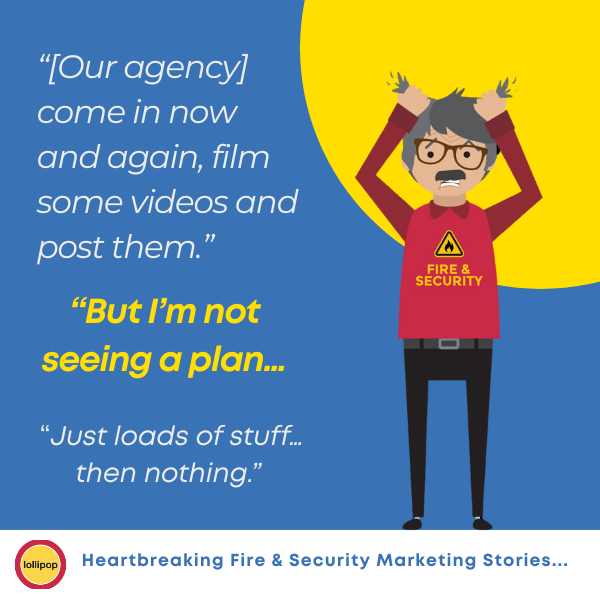
Too many Fire and Security companies struggle with scattered marketing because they don’t have a real business growth strategy. On a call with a potential customer talking about the marketing strategy of their existing agency…
“They come in now and again, film some videos and post them.
But I’m not seeing a plan. Just loads of stuff… then nothing.
If I was an expert like you, I’d see what’s missing.”
It isn’t about doing more – it’s about doing the right things, in the right order, with the right story behind them.
How Fire & Security firms confuse tactics with strategy (and what to do instead)
Most Fire & Security business owners will tell you they have a marketing strategy aimed at business growth. But ask what it is, and the answer sounds more like a to-do list:
- “We post on LinkedIn sometimes”
- “We’re doing SEO”
- “We upload a blog twice a quarter”
- “We send emails when we remember”
- “We’ve got a newsletter that tells people who we’ve hired”
These are all tactics. They may be useful – but without a clear strategy, they’re just scattered effort. And scattered effort doesn’t build trust, generate leads or grow your business.
Our business coach, John Paul Mendocha (author of Most Businesses Fail In the First 5 Minutes), gave us a sharp and practical summary of the book “I Have a Strategy – No, You Don’t” by Howell J. Malham Jr.
Strategy is one of the most overused and least understood words in business. Everyone talks about it, few can define it and even fewer apply it properly:
Strategy isn’t tactics. Strategy isn’t goals. Strategy is what ties everything together, so the tactics actually get you somewhere.
So what is strategy, really?
The Simple Strategy Formula
One of the best explanations JPM has seen comes from Malham’s book. It boils strategy down to this simple formula
Strategy = 4 Elements + 1 Tactic
What makes this useful is that it’s simple — but powerful. The four elements define your purpose, your plan, your actions and your goal. And the fifth piece — the Mega Tactic — is the big idea that ties everything together. It’s what gives your strategy its focus and identity.
Here’s how that looks in practice — based on a real campaign we delivered for a client:
1. Intended Purpose – Element 1 (E1)
What are you actually trying to achieve?
Start 1–2 genuine sales conversations per month with housing associations facing urgent compliance risks — like Waking Watch requirements — and position your team as a fast-response partner.
2. A Plan – Element 2 (E2)
How will you get there?
We’ll use LinkedIn to identify housing compliance leads and send direct messages offering rapid Waking Watch deployment for buildings over 11m needing post-Grenfell remediation.
3. Sequence of Actions – Element 3 (E3)
What are the steps and resources?
Week 1: Identify target contacts. Week 2: Connect via LinkedIn. Week 3: Message contacts with offer. Week 4: Follow up with value-add compliance resources. Resources: copywriter, outreach lead, LinkedIn Sales Navigator.
4. Measurable Goal – Element 4 (E4)
How will you know it’s working?
1–2 quality enquiries/month plus a growing pipeline of engaged contacts who may need urgent support later.
+1 Mega Tactic (T)
What’s the big idea that ties it together?
We position ourselves as the go-to Fire & Security provider for urgent compliance action — fast, reliable and fully aligned with regulatory standards.
This is your narrative – the story your strategy is telling. And it’s critical. It’s the throughline for your website, social content, proposals, sales calls and reputation. It needs to be felt everywhere.
In other words, when your strategy is clear and aligned — it tells a story. One that customers trust, teams can act on and the market remembers.
Strategy Isn’t Just Action – It’s Alignment
Without these 4 elements and a big idea to bring them together, your team won’t understand what they’re doing or why.
Which means:
- Sending out emails with no message isn’t a strategy.
- Posting on LinkedIn without a plan isn’t a strategy.
- Having a goal (“get more leads”) isn’t a strategy either.
In fact, Mendocha quips that people confuse tactics with strategy so often that if you took a shot of coconut tequila every time someone misused the word “strategy” in a meeting, you’d need medical attention by lunch.
Story Sells Strategy
One of the smartest takeaways from Malham’s book? Strategy only works if others believe in it. That means it has to be a story:
- A narrative your team can follow
- A vision your customers understand
- A journey that drives action
Think about Apple. The iPad wasn’t the first tablet. But it told the best story. People could see themselves using it. Strategy + story = success.
In Fire & Security, it’s no different. Think of a business that stands out not just for what it installs, but for the promise it makes — maybe it’s “compliance without complexity” or “always-available support”. That’s strategy you can feel.
So… Do You Actually Have a Business Growth Strategy?
If your current “strategy” doesn’t:
- Have a clear purpose
- Follow a plan
- Involve a series of defined actions
- Include a measurable outcome
- Rest on a compelling message (your mega tactic)
… then you don’t have a strategy. You have a marketing to-do list.
If that’s you — pause. Take 10 minutes and ask:
“Where are we going, how will we get there, and how will we know it’s working?”
Because in Fire & Security – where trust, credibility and compliance are critical – vague effort isn’t enough.
If you want a Fire and Security business growth strategy that’s built on clarity, not chaos, this 4E + 1T model is a brilliant place to start.
Want a Real Strategy to Grow Your Fire & Security Business?
We created our Ultimate Guide to Fire & Security Marketing Strategy to walk you through how to:
- Identify your niche and messaging
- Build a marketing system that works
- Stand out from the crowd and win trust
And if you’re ready to get serious about strategic marketing that grows your Fire & Security business – not just adds noise, the Lollies can help. Click the button below to book a call with Jo.
Because strategy isn’t about doing more. It’s about doing what matters – on purpose.