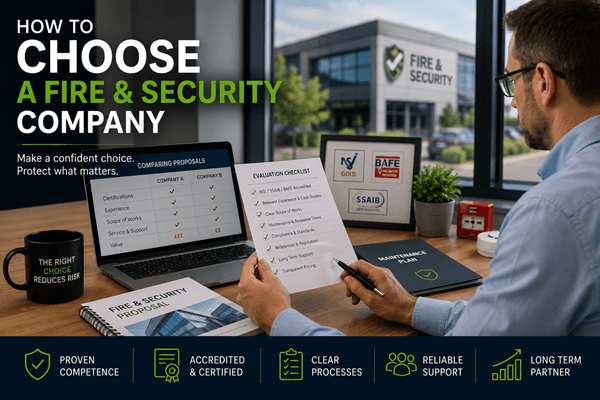
Knowing how to choose a fire and security company correctly is more consequential than most buyers realise — and more complicated than most suppliers make it easy to understand.
Under the Regulatory Reform (Fire Safety) Order 2005, the Responsible Person must ensure appropriate fire-fighting and fire detection measures are in place and, where necessary, nominate competent persons to implement them. In practice, that makes contractor competence a critical part of due diligence when appointing a fire safety supplier.
This article explains what competence means in practice, how to verify it and what a well-run fire and security company will be able to demonstrate before you appoint them.
Why “Experience” Is Not the Same as Competence
Many fire and security companies lead with how long they have been trading. Thirty years in the industry. Thousands of installations. Decades of experience.
When you are thinking about how to choose a fire and security company, experience matters — but it is not the same as competence. A company that has been installing fire alarm systems for twenty years may have been working to a standard that was superseded fifteen years ago without realising it. The standards that govern fire and security installation in the UK are updated regularly. Competence requires not just experience but current, independently verified knowledge and practice.
That is why third-party certification exists. It is not just a badge. It is evidence that an independent, UKAS-accredited body has assessed the company’s management systems, technical standards, and installation work against current British Standards — and found them to be compliant.
What BAFE Registration Tells You
For fire safety work, BAFE (British Approvals for Fire Equipment) registration is the clearest single indicator of competence. A company registered to BAFE SP203-1, for example, has been independently assessed against BS 5839-1 — the British Standard that governs the design, installation, commissioning and maintenance of fire detection and alarm systems.
BAFE operates as a scheme owner, licensing UKAS-accredited certification bodies — primarily NSI and SSAIB — to assess and register companies against its schemes. A company that is BAFE registered has passed that independent assessment. A company that is not has not.
BAFE schemes cover specific disciplines. SP203-1 covers fire detection and alarm systems. SP203-4 covers emergency lighting. SP101 covers portable fire extinguishers. A company may hold registration under one or more schemes — but registration under one does not imply competence in another.
It is also important to check the modules covered within a scheme. Under SP203-1, a company may be certificated for design, installation, commissioning, maintenance or a combination of these.
The certificate needs to match the work you are appointing them to carry out — a company certificated for installation only is not automatically certificated for ongoing maintenance.
What NSI and SSAIB Certification Tells You — and What It Does Not
NSI (National Security Inspectorate) and SSAIB (Security Systems and Alarms Inspection Board) are the two UKAS-accredited certification bodies that operate across both fire and security. Both are recognised by police forces and insurers as evidence of competent practice.
The important distinction for buyers is that certification scope matters. NSI and SSAIB both operate schemes for security guarding services and for electronic security system installation — but these are entirely separate certifications. A company certified for security guarding under NSI or SSAIB is not automatically certified for CCTV or intruder alarm installation. Those require separate certification under different scheme criteria.
The gap between intention and practice is significant.
The NSI and BAFE Fire Safety Buyers Report 2026 found that 84% of buyers believe they use a certified provider — yet 73% either do not know who certifies their supplier, are unsure whether their supplier is certified or use a supplier that is not independently certified at all.
Certification is valued. It is simply not being verified consistently.
This distinction has practical consequences. A guarding company may present NSI or SSAIB certification as evidence of overall competence — and a buyer who does not know the scope of each scheme may accept that without realising it does not cover the installation work being commissioned.
p>When you are evaluating a supplier’s certification, ask specifically which scheme they are certified under and confirm that it covers the scope of work you are appointing them for.
You can verify NSI certification through the NSI approved company search and SSAIB certification through the SSAIB Find a Supplier directory. Both are publicly accessible.
Individual Engineer Qualifications
Company-level certification is important but the Responsible Person should also ask about individual engineer qualifications too.
For fire alarm work, engineers should hold recognised qualifications such as those issued by the Fire Industry Association (FIA) or equivalent. For emergency lighting, BS 5266 compliance work should be carried out by engineers with relevant competency. A well-run fire and security company will be able to tell you which qualifications their engineers hold and how they keep up to date with standard changes. This matters because standards evolve — a qualification held once is not the same as current, maintained competence.
Questions Worth Asking Before You Appoint
A credible fire and security company should be able to answer the following clearly and without hesitation:
- Which BAFE schemes are you registered under — and does that registration cover the specific work I am appointing you for?
- Are you certified by NSI or SSAIB — and under which scheme?
- Can you show me evidence of installations in premises similar to mine?
- What qualifications do the engineers who will carry out this work hold?
- If a standard or scheme requirement changes, how does your business track and respond to that?
A company that meets the right standard will welcome these questions. A company that deflects them — or responds with how long it has been trading rather than what it can demonstrate — may not be the right appointment.
What Good Looks Like
A well-run fire and security company should not wait to be asked. Before you have raised any of the questions above, they should be presenting you with their BAFE registration certificate, their NSI or SSAIB certification documents, evidence of scheme scope, examples of comparable installations and documentation of their engineers’ qualifications.
The companies that make competence easy to verify are the ones that take their obligations seriously — and understand that yours sit alongside theirs. We looked at why proactively evidencing competence matters from the installer’s perspective in a separate piece — and the principle works in both directions.
Where to Find Certified Companies
When deciding how to choose a fire and security company, the most reliable starting points are the official directories maintained by the certification bodies:
The BAFE registered company search covers fire safety across all BAFE schemes. The NSI approved company directory covers both fire and security. The SSAIB certificated company directory covers security systems, fire detection and alarm, and manned security services.
All three are searchable by location and service type, and all show current certification status.
If you are a Responsible Person looking for a certified fire and security company, the directories above are the right starting point.
If you are a fire and security installer who holds the right certifications and wants buyers to be able to find and verify you easily, that is exactly what we help with.
You can book a call with Jo to find out how.
This article references UK fire safety legislation for context. It is not legal advice. For specific compliance or due diligence questions, readers should seek advice from a qualified solicitor or competent fire safety professional.