At some point, many Fire Alarm companies start searching for the same thing.
Fire alarm leads.
If the phone rang more often, surely more work would follow.
So installers begin exploring services promising:
- fire alarm leads
- security leads
- pay-per-lead enquiries
- shared leads sent to multiple installers
At first the idea seems logical. More leads should mean more installations.
But many companies discover something frustrating very quickly.
Most of those leads rarely turn into real work — and the reason isn’t usually the lead provider. It’s that a lead and an enquiry are not the same thing.
The Problem With Most Fire Alarm Leads
Many lead generation platforms operate in the same way.
A potential customer fills out a form saying they want a fire alarm installation, servicing or upgrade. That enquiry is then sold or distributed to several installers at the same time.
The installer receives the details and calls the prospect. But by that point the customer has often:
- submitted the same enquiry to several companies
- started comparing quotes purely on price
- spoken to multiple installers already
The installer with the lowest price often wins, regardless of BAFE registration, third-party certification or years of experience with similar premises. For companies that have invested heavily in training, certification and quality engineering, competing purely on price rarely leads to profitable work.
Leads vs Fire Alarm Enquiries: Why the Difference Matters
Understanding the difference between a lead and an enquiry is critical.
A lead is simply a contact detail from someone who expressed a vague interest.
An enquiry is something very different.
An enquiry usually comes from a buyer who has already researched installers, reviewed several companies and decided that one or two look credible enough to contact.
By the time that enquiry arrives, the buyer often already believes the installer understands what they are doing.
This is why many Fire & Security companies prefer inbound enquiries — buyers picking up the phone or coming through the website themselves — to purchased leads where the installer has to chase a cold contact.
An inbound enquiry arrives later in the buying process, from someone who has already decided you’re worth talking to. A purchased lead is the opposite: a contact who hasn’t necessarily chosen you, and may not even remember filling the form in.
The same trap catches installers who try to buy their way out of it through paid advertising. Connor, a fire door installer we worked with, had hit exactly this wall. He was spending around £900 a month on Google Ads and winning around £900 a month of work — generating leads and even closing sales, but making no actual profit on the investment. The work coming through wasn’t the kind that opened the door to maintenance contracts either. He was busy, but going nowhere.
As Connor put it: “I didn’t have a clue what I was doing on my Google Ads — just wasting money and digging myself deeper and deeper.”
We showed him how to restructure the campaign so the spend stopped haemorrhaging on unqualified clicks. That fixed the immediate bleed. The bigger question — being found consistently by buyers researching fire door installers properly, the kind with bigger projects and long-term maintenance needs — was a conversation for when the budget was right.
Why Fire Alarm Buyers Research Before Contacting Installers
There’s a reason fire alarm buyers do their homework before they call.
Under the Regulatory Reform (Fire Safety) Order 2005, the Responsible Person for a premises — usually a building owner, employer or managing agent — has a legal duty to appoint competent people to carry out fire safety work.
That changes everything about how they buy. They’re not just choosing a contractor. They’re choosing someone they’ll have to defend appointing if something ever goes wrong — to insurers, to auditors, to the fire service if it comes to it. And to defend that choice, they need to have done proper research before they made it.
So before they pick up the phone, most buyers will:
- search online for fire alarm installers in their area
- review company websites for relevant experience
- check BAFE registration and NSI, SSAIB or equivalent third-party certification
- look for evidence of experience with similar premises and systems
By the time they send an enquiry, the shortlist has already been built. The companies they contact are the companies that looked credible during that research. Everyone else has already been quietly eliminated — not by a sales pitch, but by being invisible at the point the decision was being made. We mapped this buying process in detail in Customer Journey Mapping for Fire and Security Companies.
What Visible Competence Actually Looks Like
The companies that receive consistent enquiries aren’t necessarily better installers. They’re installers whose competence is easier to see.
When a Responsible Person is researching a fire alarm company, they’re not looking for a brochure. They’re looking for evidence they can stand behind. That means being able to quickly understand:
- the types of premises the company specialises in — care homes, schools, listed buildings, manufacturing, healthcare
- the certifications they hold and the bodies that audit them — BAFE registration with NSI, SSAIB or equivalent
- the scale and complexity of systems they regularly deliver
- the organisations who already trust them — and what those organisations say about the experience
Most installer websites don’t show this. They show a list of services — fire alarm installation, maintenance, servicing — and a contact form. To a buyer doing due diligence, that’s almost useless. Three websites with three identical service lists give them no way to differentiate, so they fall back on the only visible variable: price.
The websites that produce enquiries do something different. They explain what the company is genuinely good at, who it’s done it for, and what the evidence is. The enquiry that arrives isn’t random — it’s the end of a research process that may have been underway for days or weeks. By the time the phone rings, the buyer has already decided this is a company worth talking to.
That’s the difference between chasing leads and being discovered by buyers who already trust your competence. We’ve mapped the discovery process in more detail in How Fire Alarm Companies Get More Customers.
Why Serious Installers Focus on Visibility Instead of Leads
Purchased leads behave like a tap. While you’re paying, contacts trickle in. The moment you stop paying, the trickle stops too. There’s no asset, no momentum, nothing left behind. Whatever you were spending each month, you’ll be spending again next month — or the work disappears.
Visibility behaves differently. Each piece of work you do to make your competence findable — a properly written services page, a case study from a job you delivered, evidence of certifications and specialisms, content that answers the questions buyers are already asking — keeps working long after it’s published. Six months on, that page is still being found. A year on, it’s still drawing buyers into your shortlist. The cost per enquiry doesn’t rise — it falls.
This is the honest trade-off. Visibility takes longer to build than leads take to buy. There’s no instant tap to switch on. But the work compounds, and the installers who commit to it stop experiencing the workload pattern that catches everyone else out — the boom-and-bust cycle of relying on whatever channel is currently producing contacts. We explored that pattern in detail in Why Many Fire & Security Companies Struggle to Win Consistent Work.
The companies that get this right end up in a fundamentally different conversation. Instead of cold-calling shared leads or chasing names from a directory, they’re talking to buyers who’ve already decided they look credible. Fewer time-wasters. More buyers ready to move. If you’re trying to work out what a sensible visibility budget actually looks like, we covered the question in How Much Should Fire & Security Companies Spend on Marketing.
What This Looks Like Over Time
The shift from buying leads to being found doesn’t happen overnight, but it does happen in a recognisable pattern.
Early on, the changes are subtle. A few enquiries arrive that don’t look like the usual lead-form pattern — a longer message that mentions a specific premises type, a buyer who already knows your certifications before the first call, a question about a particular type of system rather than a generic “can you give me a quote.” These are the first signs that buyers are finding you during their research rather than being routed to you by a platform.
As more pages, case studies and evidence of competence build up, those enquiries become more frequent. The conversion rate on them is noticeably higher, because the buyer has already done the qualifying work themselves. Quotes turn into installations more often. Site visits happen because the customer already wants you — not because they’re comparing five companies.
Over time, the balance changes. Inbound enquiries from buyers who’ve researched you become a meaningful share of the work coming in — alongside referrals, not instead of them. The business stops depending on whichever channel is producing contacts this month, because more than one channel is doing real work. And when those enquiries arrive, the next challenge is converting them properly — something we cover in How to Follow Up Fire & Security Quotes Without Losing the Sale.
Stop Buying Fire Alarm Leads. Start Being Found.
Fire alarm leads can sometimes create activity. But the companies that build the most stable businesses focus on something more powerful: consistent visibility to buyers who are actively researching suppliers.
When those buyers discover your company during their research, enquiries arrive naturally — and the sales conversation begins long before the phone rings.
Many installers who finally pick up the phone to us tell us a version of the same thing: “I wish I’d spoken to you before I wasted so much money.” By the time they call, they’ve usually already spent thousands on shared leads, badly-set-up paid ads or directory listings — chasing activity instead of building visibility to the buyers who were going to research them anyway.
If you’d like to understand how visibility creates consistent fire alarm enquiries, explore more articles in our Fire & Security Marketing Insights — or if you’d rather skip ahead and look at where the gaps are in your own visibility, book a Visibility call with Jo.
This article references fire safety legislation applying in England and Wales for context. Different legislation applies in Scotland and Northern Ireland. It is not legal advice. For specific compliance or due diligence questions, readers should seek advice from a qualified solicitor or competent fire safety professional.
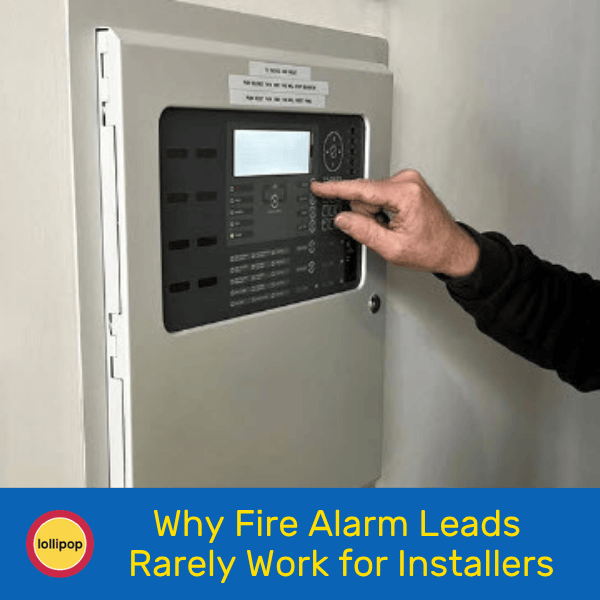
Featured image: fire alarm panel installation by TR Fire & Security Ltd.