If your website says your team is “certified” to inspect fire doors, do you know exactly what that means?
More importantly: does your reader?
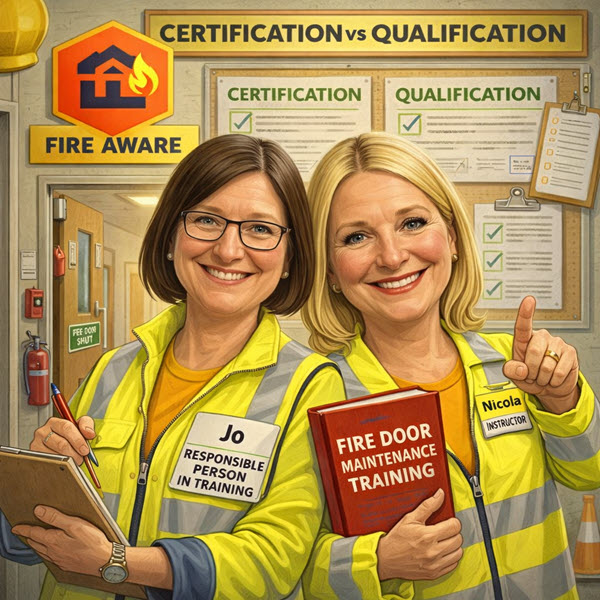
This summer, our MD Jo Shaer was appointed as one of the Responsible Persons for her apartment block after an RTM (Right to Manage). Since 2010, she’s been writing for fire and security businesses. So she thought she’d have a head start on understanding competence.
She didn’t.
That’s because the fire door world is flooded with overlapping schemes, confusing acronyms and qualifications that sound official but don’t all carry the same weight. Some are third-party certifications. Others are Ofqual-regulated qualifications. Some are short CPD or awareness courses — useful for keeping knowledge current, but not designed to demonstrate competence on their own.
Jo spoke to Nicola John of FDM Training & Development — Managing Director of the UK’s first practical fire door training academy and a regular voice on industry competence — to try and make sense of it all.
The conversation didn’t simplify the picture — it clarified what actually matters.
From Doing the Job to Proving the Job Was Done Properly
Eight years on from Grenfell, and post-Building Safety Act, the conversation about fire doors has shifted.
The industry is no longer asking “have we done enough?”
It’s asking can we show what we did, why we did it, and that it was done by competent people?
That word — competent — is where most websites quietly fall over.
Speaking on the IFSJ Leaders in Fire & Safety Podcast, Nicola described competence as a “competency jigsaw” — never finished, made of multiple pieces that come from different places, and unique to each individual.
The four pieces are:
- Skills
- Knowledge
- Experience
- Behaviours
Together, they form what the industry calls SKEB — the four-factor definition of competence set out in Regulation 11F of the Building Regulations 2010, introduced via Part 2A in 2023 following the Building Safety Act. We’ve covered why proving installer competence is now a marketing job, not just a compliance one.
And here’s the part that breaks most website copy:
- A certification scheme sits at company level. It checks that an organisation or process meets a particular standard.
- An Ofqual-regulated qualification sits at individual level — and the better ones (like FDM’s GQA Level 3 Diplomas in Fire Door Inspection and Installation) don’t just teach. They assess applied competence on site, including the experience and behaviours pieces of the jigsaw.
- A short CPD course or an online certificate might fill in one piece of someone’s jigsaw — but it isn’t the whole picture, and it shouldn’t be marketed as one.
If your website blurs these things together, you’re not just risking confusion. You’re risking a gap between what your copy implies and what your team can actually demonstrate.
For more on how competence is actually proved in fire safety law — including the SKEB framework, Article 18, Article 33 and Regulation 11F — see our guide on how to prove competence in fire safety and where third party certification fits in.
What Fire Door Competency Claims Mean on Your Website
Fire and security websites often make broad claims like:
- “All our engineers are certified”
- “We are fully accredited to carry out inspections”
To a Responsible Person reading this — especially one who has just been appointed and is feeling the weight of Article 18 of the Regulatory Reform (Fire Safety) Order 2005 — these phrases raise more questions than answers:
- Certified by who?
- Accredited to what standard?
- Does the certification cover the person turning up on site, or just the company?
- If something goes wrong and the RP has to rely on the Article 33 due diligence defence, would your copy actually help them evidence that they appointed competent people?
Or would it leave them trying to justify a decision they can’t prove?
That’s the question most websites have never been written to answer.
A badge on a website tells you something about a company. A regulated qualification tells you something about the person turning up on site. The two are not interchangeable — and Responsible Persons who have read up on their duty know it.
If that difference isn’t clear in your copy, Responsible Persons are left to fill in the gaps themselves. Many will simply move on to the company that explains it better.
This is where good copy matters. It bridges the gap between technical reality and marketing clarity — and gives buyers something they can actually evidence when they’re held to account for their supplier choice.
Speak the Language of Trust
At Lollipop, we specialise in writing for fire and security companies who want their content to be more than filler.
- Asking the awkward questions about schemes, awards and diplomas
- Making sure claims are accurate, up to date and checkable
- Writing for the real concerns of Responsible Persons — not just Google
We help fire and security companies turn complex competence into content a Responsible Person can understand, justify and stand behind.
If you’d like your website content to reflect real competence — not just say the right words — get in touch with Jo.
We’ve been writing for fire and security companies since 2010… and we’ve never stopped learning.
This article references fire safety legislation applying in England and Wales for context. Different legislation applies in Scotland and Northern Ireland. It is not legal advice. For specific compliance or due diligence questions, readers should seek advice from a qualified solicitor or competent fire safety professional.