How many Fire & Security quotes have you sent this year that never received a reply?
£10,000… £50,000… £100,000 worth?
Most installers have been there. You carry out a site survey, prepare a proposal, send the quote — and then silence.
The instinct is to assume the job was lost on price. But in many cases the customer hasn’t rejected the quote at all. They’re still thinking about it.
They might be comparing installers. Waiting for internal sign-off. Or trying to work out which option is the right one for their building. You can find out more in Why Some Fire & Security Enquiries Convert Easily (And Others Don’t).
The problem is that most Fire & Security companies hesitate to follow up — because they don’t want to appear pushy. That hesitation quietly leaves work on the table.
We see this regularly when companies start examining their sales process more closely. It’s one of the reasons many installers feel their workload fluctuates — something we explored in Why Many Fire & Security Companies Struggle to Win Consistent Work.
And even when companies are generating enquiries — through referrals or improved visibility — the work can still be lost at this stage if quotes aren’t followed up consistently. We covered how installers attract those enquiries in How Fire Alarm Companies Get More Customers.
Why Fire & Security Quotes Often Go Quiet
When a customer receives a quote for a Fire or Security system, they rarely make an immediate decision.
There are usually several things happening behind the scenes.
- They may be comparing quotes from two or three installers.
- The project may need approval from a manager, director or facilities team.
- They might be reviewing budgets or waiting for the next financial period.
- They may have unanswered questions about the system or the installation process.
But there’s something else most installers miss.
The person receiving your quote often isn’t making a casual purchase. Under the Regulatory Reform (Fire Safety) Order 2005, Responsible Persons — building owners, employers, managing agents — have a legal duty to appoint competent people to carry out fire and security work. That means your quote isn’t just being weighed on price. It’s going through an internal compliance and approval process.
Silence doesn’t mean rejection. It often means they’re still working through that process — and the installer who checks back in at the right moment is the one who ends up in the conversation when the decision gets made.
That process usually involves people you have never met. Who really makes the fire and security buying decision covers who they are and what your contact needs from you to carry the recommendation.
Here’s a real example of a cautionary tale. A few years ago, we accepted a quote from a supplier — said yes, confirmed we wanted to proceed. Six weeks later, we still hadn’t received an invoice. We had to chase them…. twice!
They’d already won the job and then ghosted us. If we hadn’t needed them urgently, that job would have quietly disappeared — not because WE changed our minds, but because THEIR process just stopped. If we had had a choice, we would have gone somewhere else who actually made us feel valued as a customer.
The Fire & Security Sales Gap
Many opportunities are lost in the small gap between sending a quote and the customer making a decision.
For many installers, the process looks like this:
Customer enquiry
↓
Site survey
↓
Quote sent
↓
Customer goes quiet
↓
No follow-up
↓
Job goes to a competitor
When this happens it’s easy to assume the quote was too expensive. But in reality the customer may simply have needed reassurance, clarification or a short conversation to move forward.
The process that actually wins the job looks like this:
Customer enquiry
↓
Site survey
↓
Quote sent
↓
Follow-up conversation
↓
Questions answered
↓
Installation agreed
The difference between those two outcomes is often a single phone call.
How to Follow Up Fire & Security Quotes Without Being Pushy
Many engineers and project managers worry that following up will make them sound like a salesperson chasing a deal.
But for a lot of installer businesses, the follow-up doesn’t fall to the engineer who did the survey — it falls to an admin team member who wasn’t there. They didn’t build the relationship, they don’t know what was discussed on site and they genuinely don’t want to be a nuisance. So the call doesn’t happen.
That’s not a people problem. It’s a process problem. A simple system — even just a note in the diary three days after a quote goes out — takes the awkwardness out of it and makes follow-up a normal part of how the business operates.
Good follow-up isn’t about pressure. It’s about helping the buyer resolve uncertainty. A short, friendly conversation often gives the customer the chance to ask questions they hadn’t raised before. Simple openers work well:
- “Just checking whether any questions came up after reviewing the proposal.”
- “Was everything in the quote clear, or would it help if I walked you through it?”
- “Is there anything you’re still considering before moving ahead?”
A phone call works better than an email — it’s harder to defer and easier to have the actual conversation.
These conversations aren’t about persuading someone who doesn’t want the system. They’re about helping someone who may already be leaning toward you but needs a bit more certainty before making the call.
Timing Matters More Than Scripts
One of the most common mistakes is waiting too long before following up.
Leave it a fortnight and the opportunity has often moved on. A check-in a few days after sending the proposal is enough — it shows the customer you’re attentive, professional and available if they have questions. In many cases, that brief conversation is all it takes to move the project forward.
Not Every Quote Should Be Chased Forever
Following up a quote is important, but it doesn’t mean chasing every opportunity indefinitely.
Some enquiries simply aren’t the right fit. The customer may not have the authority to approve the work, the project may not have a realistic budget, or the installation may not match the type of systems your company normally delivers.
A quick follow-up conversation usually reveals whether the opportunity is genuine. If the customer is engaged, asking questions and discussing next steps, the project is likely moving forward.
If there is no decision maker, no clear budget and no urgency, it may simply be a quote that helped someone gather information.
Good sales teams recognise the difference. They follow up professionally, answer questions and help genuine buyers move forward — but they don’t spend weeks chasing opportunities that were never likely to proceed.
That balance is what separates a productive sales process from one that just keeps busy.
Old Quotes Aren’t Always Dead Quotes
Here’s another real example — nothing to do with fire and security this time.
We were quoted by two double glazing companies. Neither followed up. We wanted the windows done but life got in the way — we were too busy to make the call ourselves. So it just didn’t happen.
A year later, we still hadn’t got it done. Still wanted it done. If either of those companies had picked up the phone — even twelve months later — they’d have won the work on the spot. Not because we’d suddenly decided we wanted new windows. We’d always wanted them. We just needed someone to bring it back to the top of the pile.
The same is true in fire and security. Quotes that went quiet six months ago aren’t necessarily lost. The budget may have been approved. The project may have been reapproved. The person who originally enquired may simply be waiting for someone to re-open the conversation.
A quick check-in costs nothing. And occasionally it wins a job that had been sitting dormant for months.
Following Up Is Part of the Sales Process
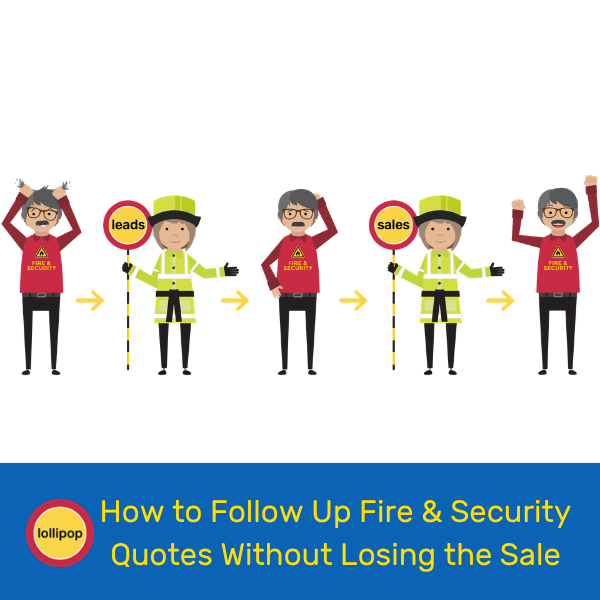
Many Fire & Security companies focus heavily on generating new enquiries. But for most installers, the fastest wins are already in the pipeline — in the quotes that haven’t been followed up yet.
Improving what happens after a quote is sent can increase sales without generating a single extra lead. It doesn’t require new marketing spend, new systems or new leads. It just requires a consistent process.
When companies respond quickly to enquiries, follow up quotes consistently and answer buyer questions clearly, more of those conversations convert into installations.
We cover that wider process in more detail in How to Increase Fire & Security Sales.
For the full picture of how follow-up fits into a consistent growth system, see How Fire & Security Companies Generate Consistent Work.
The Quotes You’ve Already Sent Are Worth Following Up
If you’d like to look at how your current quote-to-conversion rate stacks up — and where the gaps are — that’s exactly the kind of thing we look at with installers. Find out how our Sales Acceleration service for Fire & Security companies works, or if you’d rather talk it through, book a call with Jo and we’ll take a look together.
This article references fire safety legislation applying in England and Wales for context. Different legislation applies in Scotland and Northern Ireland. It is not legal advice. For specific compliance or due diligence questions, readers should seek advice from a qualified solicitor or competent fire safety professional.