
Before your Fire & Security buyers appoint you, they can check you. They look for evidence that you can do the job, including your third-party certification and work you’ve done for premises like theirs. Then they make sure they could defend the choice to someone else – such as an insurer.
Nobody can check a marketer that way. Professional bodies for marketers exist, but nothing audits a marketer’s work the way NSI or SSAIB audit an installer’s. So the checking falls to you.
The cost of getting it wrong is easy to miss until the enquiries dry up.
A salesperson at one Fire & Security installer told us his website forms had produced no new enquiries at all in four months. In the same four months the phone had rung once with a cold lead who wasn’t already a customer. And there had been no inbound email enquiries.
His marketing team’s plan was a blanket campaign of more awareness posts on social media. Nobody had a real plan to bring more people to the website. Nobody had a plan to turn the visitors it already had into enquiries.
The choice is often framed as agency vs in-house marketing. In practice there are four routes: do it yourself, take it in-house, hire a freelancer or appoint an agency. Each suits a different situation. None of them removes the need to check who you’re trusting with your reputation.
Start With What the Marketing Has to Do
A Fire & Security company once asked us how marketing could help them sell the business. The plan was to grow it, sell it and retire.
Then they met another agency. The next time we spoke, the sale had dropped out of the conversation. They wanted a quote for a website where staff could log in and read the employee handbook.
A staff handbook has its place. It does nothing to make a company more attractive to someone looking to buy it.
Every supplier sells what it already knows how to do. A web developer will suggest a bigger website with more to build. A designer will suggest a rebrand. A print firm will suggest leaflets. Each recommendation starts from the supplier’s skills rather than from your plans.
So before you speak to anyone, write down what the marketing has to achieve over the next few years. More commercial enquiries, more maintenance contracts or a business someone will want to buy. Then judge every option against that list.
Doing It Yourself
On paper, doing your own marketing is the cheapest route. The cost is your time.
Marketing needs learning, writing, publishing, measuring and adjusting, week after week. It competes for your attention with quoting, managing engineers and chasing payments. When the week gets busy, marketing is the easiest thing to drop.
Someone has to own the marketing. When the person who owns it is also running the company, one of the two jobs slips.
AI tools have made doing it yourself look easier. They can draft a blog post or a social media update in seconds. We use them in our own work. What they can’t do is decide what your marketing should achieve, know which jobs you want more of or check their own facts. We keep a running list of the mistakes AI tools repeat in Fire & Security content, such as describing a company as “accredited” when it’s certified. A buyer who checks certification will notice details like that, so every AI draft needs someone who knows the sector to check it before it goes out.
If you do go it alone, learn from people who do the work themselves. We have seen a LinkedIn course teaching features that had been removed a year earlier. We have seen an SEO (search engine optimisation) course run by someone whose own website showed little sign of SEO. Both courses had glowing reviews. The people writing them were beginners who didn’t yet know enough to spot what was missing.
Before you book any course, look at the trainer’s own recent activity on the platform they teach.
Taking It In-House
Handing marketing to someone already on the payroll is tempting. They know the business and the customers. They’re keen to help.
One Fire & Security company promoted a surveyor with an older marketing degree to marketing manager. The directors soon found his skills were out of date.
Promoting from within brings three costs that are easy to miss. You pay twice for the learning, once in course fees and again in time. While someone is learning, they aren’t marketing. If marketing sits alongside their old job, it will come second whenever the old job gets busy.
There’s also the question of authority. Good marketing depends on getting information out of senior people about jobs, prices and customers. A junior or newly promoted marketer may not have the standing to ask for it.
Family members bring an extra layer. We have seen sons and daughters with marketing degrees take charge of a family firm’s website and build something busy and technical that was hard for Google to find and said little about the buyer’s problems. When no leads were forthcoming, other staff found it hard to raise concerns about the boss’s own child.
An apprentice is affordable but needs supervision, spends time away on their course and rarely has the experience to shape how the company presents itself. One marketing manager we know had a capable apprentice who qualified… and then moved straight to the sales desk for the commission.
An experienced marketing manager solves the authority problem. One person still rarely holds every skill a full marketing plan needs, from the website and search to writing, design, advertising, email and reporting. Many in-house marketers end up buying some of those skills in. Every employee also brings payroll, pension, holiday and sickness cover with them.
Hiring at that level has its own risk. A Fire & Security business owner told us he advertised for a marketing manager to write the plan and then carry it out. He’s paying a manager’s salary. What he got was someone who needs the plan handed to them and checked at every stage. The planning has landed back on his desk.
A job title on a CV is no easier to check than an agency’s sales pitch. Ask any candidate to show you a plan they wrote and what happened when they ran it.
Hiring a Freelancer
A freelancer suits you when you already have a plan and need one gap filled, such as design or website updates. Good freelancers are specialists and you only pay for the work you need.
The risk is paying for someone to learn. One business owner asked the web designer he trusted to set up a pay-per-click (PPC) advertising campaign. The designer took the job instead of admitting it wasn’t his skill. The owner only found out after several months of wasted advertising spend.
In another case, a developer moved into local SEO, set up the company’s map listing wrongly and then emailed his own contact list in his new client’s name. That was a data protection problem as well as a marketing one.
Capacity is the other risk. Many freelancers work alone for several clients. When another client shouts louder, their work goes first and your deadline slips. If you need several freelancers to cover several skills, you also become their project manager.
Ask any freelancer for results in the specific skill you’re hiring them for. Then start with a small paid project before you hand over anything large.
Appointing an Agency
An agency gives you a team with several skills, cover when someone is off and no recruitment to manage. It can take on the whole job or work alongside an in-house marketer, providing the plan or the specialist skills while your own person stays in charge. That mix can suit better than either option on its own.
Agencies fail too. A Fire & Security director told us he had paid an agency a monthly retainer for “social media and website stuff” for the best part of a year. His enquiries didn’t rise at all. In the end he pulled the plug.
A quick look at the work showed why. There was no plan to bring visitors to the website. There was nothing on the website to turn those visitors into enquiries.
Two companies who later came to us for social media training described the same pattern with their previous agencies. Posts went out with no link to website visits or enquiries. When one company asked about strategy, the agency said it wasn’t being paid enough to provide one.
Plenty of capable agencies are built for a different kind of business. We explain why a general playbook struggles in this sector on the Lollipop Local homepage.
Agency vs In-House Marketing: Which Route Suits You
| Route | Suits you when | Watch out for |
|---|---|---|
| Doing it yourself | You have time to learn and a clear plan to follow | Marketing dropping off whenever the business gets busy |
| In-house | You want someone inside the business and can fund training and support | One person rarely covering every skill, plus authority gaps |
| Freelancer | You have a plan and one specific gap to fill | Learning on your money and limited capacity |
| Agency | You need a plan and several skills working together | Activity without a plan and reports that never mention enquiries |
Cost matters as well. We cover typical budgets separately in how much Fire & Security companies spend on marketing.
How to Check a Marketer Before You Hire Them
The route matters less than who does the work. Whoever it is needs two kinds of knowledge. One is Fire & Security: what you install, the standards your work is built to and how your buyers check you before they appoint you. The other is direct response marketing: building a plan around enquiries, giving buyers a reason to get in touch, following up and measuring which activity brings in work.
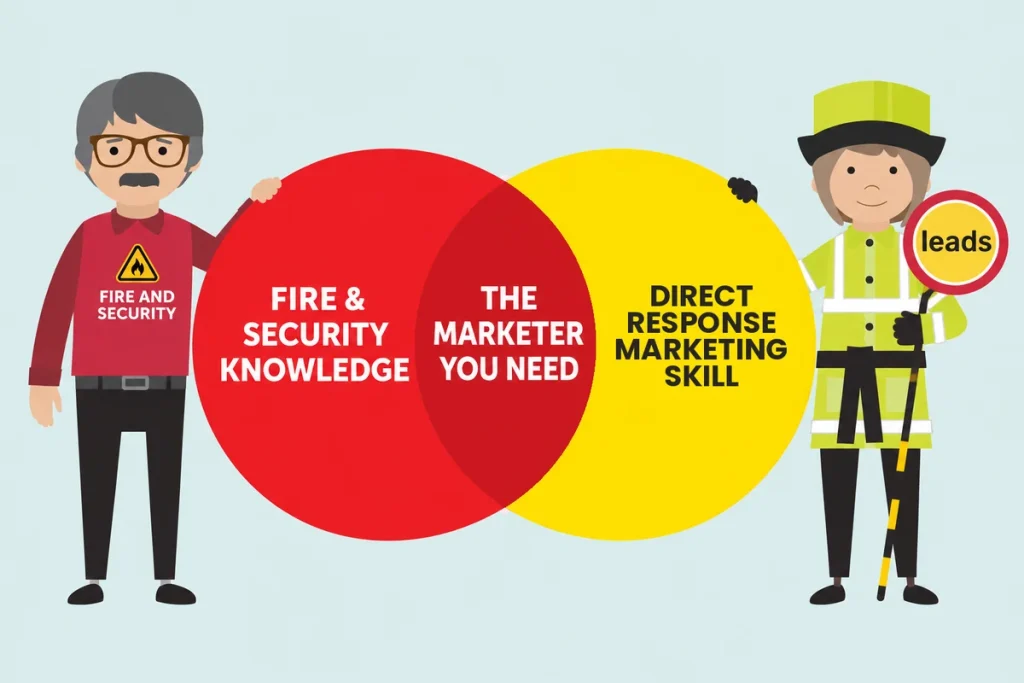
Most of the failures in this guide are missing one of the two. The surveyor and the family members knew the trade but not the marketing. The agencies posting without a plan knew how to produce activity but not how to turn it into enquiries. Generalist agencies often have the marketing skills but not the sector knowledge. Marketing that brings an installer enquiries needs both.
Whichever route you choose, these checks apply to anyone who will touch your marketing. They apply to us too.
Do they market themselves the way they’ll market you?
Look at their website, their articles and their social media. Do you like what you see? Does it suggest someone who is comfortable with creating online marketing campaigns that have a chance of success? A marketer who relies on word of mouth or cold calls and bulk emails to find new clients may not be getting many enquiries from their own marketing.
Did they learn on their own money?
Perry Marshall, author of the Ultimate Guide to Google Ads and 80/20 Sales & Marketing, is someone we still learn from. He tells business owners to hire advertising specialists who learned “on their own dime”. In our experience, someone who has lost their own budget while learning is more careful with yours.
Do their reports show enquiries and work won?
Charts of reach and impressions tell you very little. Ask to see a sample report and look for enquiries, quotes and jobs won.
We were once asked to audit the Google Ads account of a large company whose West End agency sent detailed monthly reports. None of the directors could understand them. Once we set the spending out in plain English, they could see where large amounts of money were being wasted.
Do their testimonials say what changed?
A review that says: “They were great” tells you nothing. Look for testimonials that name the person and the company and describe what actually changed. Check when each one was written. Early enthusiasm doesn’t always survive the first year.
What does the person who recommended them say six months on?
A friend’s new website looking good on launch day tells you little. Ask again after six months. Find out what they wanted the website to do, whether it has brought enquiries and whether those enquiries became customers.
The same goes for the marketer you see at networking every week. Reliable attendance and good company over breakfast say nothing about their results. One of our clients had a Fire & Security website from a networking contact that produced no enquiries in three years.
Do they understand how your buyers decide?
Your buyers look for evidence that you’re competent before they appoint you. Your marketer should know what NSI or SSAIB certification and BAFE registration each tell a buyer, what happens on a site survey and why the person appointing you has to justify the choice. Without that, your marketing will describe what you install and miss what your buyers are trying to find. That is the biggest Fire & Security marketing mistake we see. The full picture of what buyers check is in our guide to proving competence in fire safety.
A marketer who understands your sector should also be able to show you something about your own business you hadn’t noticed.
“…you told me things about our business I did not know and I keep learning. I genuinely believe you would get as much satisfaction from us doing well as we would…”
– Carl Meason, Managing Director, Fenix Monitoring
Who checks the AI’s work?
Many marketers now use AI tools, whether they’re on your payroll, freelance or part of an agency. Ask how they use it and who checks the output before anything is published. That person needs to know the Fire & Security sector well enough to spot the mistakes.
Will they tell you not to spend?
A marketer working in your interests will sometimes say no. If you aren’t yet third-party certified, your money may do more good on certification first. If your website can’t turn its current visitors into enquiries, that needs fixing before you pay for more visitors.
“…Jo was honest from the start that our marketing needed to be built on the right foundations – including the right qualifications and third-party certification. She encouraged us to get BAFE registered and make third-party certification a visible part of our positioning, so the website and marketing would be built on something solid.”
– Terry Owen, Director, Syndicate Fire Protection Service
Ask any marketer when they would advise you not to hire them. A clear, specific answer is a good sign.
Frequently Asked Questions
Is an agency cheaper than hiring someone in-house?
That depends on how many skills you need. An employee brings salary, payroll, pension, holiday and sickness cover. One person still rarely covers every skill. An agency gives you a team that you share with its other clients. Compare each option against what you need the marketing to achieve as well as against the monthly cost.
Should I hire a freelancer or an agency?
A freelancer suits a single gap when you already have a plan. An agency suits you better when you need the plan as well as several skills working together.
Can a member of staff run our marketing?
They can, provided they have the time, a training budget, the authority to get information from senior people and outside help for the skills they don’t have. Many in-house marketers work alongside an agency or freelancer for exactly that reason.
What should I ask a marketing agency before signing?
Ask how they generate their own enquiries, how they learned their advertising skills and what a monthly report looks like. Ask for named testimonials that describe what changed. Ask what they know about how Fire & Security buyers choose a supplier. Then ask when they would advise you not to hire them.
Talk It Through With Jo
If you’re third-party certified and weighing up which route fits your business, book a free Visibility Call with Jo. It takes about 45 minutes and there’s no obligation to work with us afterwards, though we hope the call shows you enough knowledge of both Fire & Security and marketing that wins work that you’ll want to.
“That [call] was inspiring! We want to sign up immediately”
– Lee Westlake, Managing Director, Armoury Security + Fire
You can see how we work with installers on our Fire & Security installer marketing page.