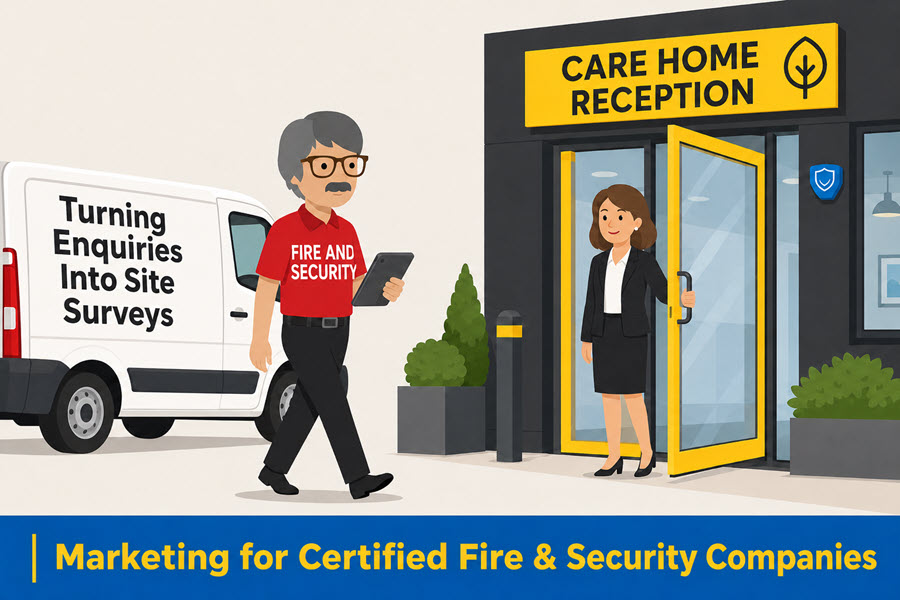
An enquiry arrives on Tuesday afternoon. A facilities manager at a care home wants to talk about upgrading the fire alarm. It lands in a shared inbox. The engineer who normally picks those up is on site until Thursday. Someone replies on Friday morning.
By Friday morning the buyer has spoken to two other companies. One of them already has a survey booked for the following Tuesday.
Nothing about that Friday reply was unprofessional. The company is certified, technically strong and perfectly capable of the work.
The fire and security site survey is the stage where an enquiry stops being a name in a form and becomes a real opportunity. Most of what we publish covers what happens either side of it. This article covers the gap itself: the distance between an enquiry landing and an engineer standing on site.
By the time a buyer contacts you, they have usually already researched you. We covered that in why some Fire & Security enquiries convert easily and others don’t. Everything below starts after that.
Speed Is the Part You Control
You cannot control how many companies the buyer contacted. You can control how long yours takes to reply.
Every hour an enquiry sits unanswered is an hour the buyer spends talking to the companies that did answer. The problem is usually structural. The person best placed to answer a technical enquiry is an engineer, and engineers are on site.
Three things settle it.
- Name an owner. One person is responsible for enquiries reaching a human the same working day. Not a rota. Not whoever notices.
- Decide what cover looks like. When that person is on site or on holiday, who picks it up, and do they have diary access to book a visit.
- Check where the enquiries actually land. Form submissions that route to an address nobody monitors, phone numbers that ring out after five, contact pages that fail silently on mobile. These are worth testing yourself, from outside the business, once a quarter.
The first reply only has to reach a person who can hold a conversation and open a diary.
What a Fire and Security Site Survey Needs to Establish First
A survey costs you an engineer for half a day, plus travel, plus design time afterwards. That spend is worth making when you know what you are walking into.
The qualifying call has a bad reputation because it is often run as a screening exercise. A serious buyer can feel that immediately. The way round it is to say out loud why you are asking. You want to give them a price that holds, and to do that you need to know a few things first. That framing changes the whole call.
What you need before you book:
- The premises. Type, use, occupancy, size, whether it is listed, whether it stays live during the works. A care home, a primary school and an empty industrial unit are three different jobs.
- What is already there. Existing system, rough age, manufacturer, who maintains it now, and whether they hold the operation and maintenance documents and the cause and effect matrix.
- What prompted the enquiry. An action plan from a fire risk assessment, an insurer, an enforcement visit, a failed service, an extension, a change of use. This is the question that changes the shape of the quote, and the one that gets skipped.
- The scope, and who set it. On the fire side, that means the system category. On the security side, the grade and environmental class.
- Who else is involved. Your contact is often not the person who signs. Find out early who else sees the proposal and what they will want from it.
- Access and timing. Keys, permits, escorts, out of hours, live areas, and when they need the work done rather than when they would like it.
Scope Is Where Quotes Go Wrong
A specification that names BS 5839-1 without naming a category does not tell you what to install. There are eight categories, and the difference between an L4 and an L1 is the difference between protecting escape routes and detecting throughout the building.
BS 5839-1:2025 recommends that consultation happens before the design stage, and that where a designer proposes a category it is agreed with the user or purchaser. The FIA guidance on BS 5839-1 fire alarm categories is clear that selecting the category is the fire safety specialist’s job rather than the alarm designer’s or the contractor’s. Which means the question on your qualifying call is whether anyone has specified a category, and who.
On the security side, PD 6662:2017 is the scheme that pulls the relevant standards together. A documented risk assessment sets the security grade. The environmental class is a separate judgement about where each component sits, from a heated office through to full exposure to weather. Insurers commonly specify a minimum grade. Police response is a further question again, resting on the police policy and on whether the system is configured to generate confirmed alarms under BS 8243. Three things to establish rather than one, and none of them safe to assume.
If nobody on the call can tell you the category or the grade, you have found a scope question that needs settling before anyone prices anything. Saying so on the phone is one of the more credible things you can do at that point in a conversation.
Book the Visit on the Call
I will send something over is a diary slot you did not get.
Offer two specific dates while you have them on the phone. Take the site address, the name and mobile of whoever will meet the engineer, and the access arrangements. Confirm it in writing the same day.
If they will not commit to a date, ask what needs to happen first. Budget sign off, a board meeting, a decision from the managing agent, another quote they are waiting on. That answer tells you which stage you are actually at, which is more useful than a soft yes.
What You Send Between Booking and Attending
The buyer has booked a visit. They have not finished checking you out. Whatever lands in their inbox over the next week either confirms the decision or reopens it.
A confirmation worth sending includes:
- The date, the arrival window and the name of the engineer attending
- Your certification in a form they can verify themselves – the scheme, the certificate number and where to look it up
- One example of a comparable premises, named if you have permission and described generically if you do not
- What you need from them on the day, including plans, existing documentation, asset register, access and any permits
Be precise about what your certification covers. Third-party certification is scope specific. NSI and SSAIB certify companies to defined scopes, and BAFE registration is scheme and module specific. A buyer who checks the register and finds your scope narrower than your email implied has learned something you did not want them to learn a week before the survey.
A brochure adds nothing here. A verifiable certificate reference does.
Who Turns Up
The survey is the first time the buyer meets your company as people rather than as a website.
Company certification tells a buyer the business operates within an assessed scheme. It says nothing about the individual standing in their plant room. That is a separate layer of evidence, and the survey is where it becomes visible.
Send someone who can answer the technical question in the room. If they cannot, the better answer is that they will confirm it and come back, followed by actually coming back. If the person surveying is not the person designing, say so and explain how the handover works. Buyers are far more comfortable with a named process than with a vague reassurance.
Individual qualifications are worth naming in the confirmation email. The ECS FESS scheme, for example, covers four disciplines: fire; fire and emergency lighting; security; and fire and security. Within those disciplines, ECS recognises Systems Operative, Systems Technician and Technical Manager. If your engineer holds a card, the buyer can check what it means.
The Enquiries That Should Not Become Surveys
Qualifying out is a margin decision. Every survey you attend that was never a realistic opportunity takes time away from work that was.
The signals show up on the first call. A buyer who will not describe the premises. A buyer who wants a price before a visit. A buyer who has three quotes and is comparing them on a single number. A scope that sits outside what you are certified to deliver.
That last one is the clearest. Taking work outside your certification scope creates a problem that arrives later and costs more than the job was worth. Declining it and passing the buyer to someone who does hold that scope protects your position and sometimes comes back to you as a referral.
Turning an enquiry down properly means explaining why, in terms the buyer can use. It reads as competence.
From the Survey to the Quote
Everything above is the work that makes a survey worth attending. It sits inside a wider pattern we set out in why some Fire & Security companies grow while others stay stuck.
The engineer leaves site and the next stage begins. A proposal goes out, and then the buyer goes quiet while people you have never met discuss it. We cover that stage in how to follow up Fire & Security quotes without losing the sale.
If your enquiries are arriving and stalling somewhere between the inbox and the diary, that gap is often worth looking at before you spend anything extra on marketing. Book a call with Jo and we can look at where yours are going.